Anshun (安順市) earns a place on a South China route because it holds Huangguoshu Waterfall, the largest waterfall in China and one of the widest in the world. For a Guizhou itinerary built around Guiyang, the Miao villages and the karst landscape, Huangguoshu is the single most imposing natural spectacle in the province and the obvious anchor for the west. It is a landscape destination first and a city visit second, which is exactly how to plan around it.
What Anshun and Huangguoshu actually are
The city of Anshun is a regional centre in western Guizhou, but the visitor interest is the Huangguoshu Scenic Area, centred on a waterfall about forty-five kilometres southwest of the city. The main fall drops roughly seventy-eight metres and spans about a hundred metres, and it is unusual in being viewable from several directions, including from behind, through a natural cave set into the cliff. The area is not one fall but a cluster of eighteen waterfalls, described as the largest waterfall group of its kind, with the scenic zone spread across several kilometres of karst terrain connected by shuttle buses.
Who it suits
Huangguoshu suits travellers who want a major natural set piece, who are already in Guizhou, and who do not mind a busy, managed park. It works for families, older visitors and first-time travellers because the paths are built and the shuttle system reduces walking. It is less suited to people seeking solitude or untouched wilderness, since the falls are a headline attraction and the main viewing areas get crowded. Treat it as a half-day to full-day spectacle rather than a remote adventure, and it delivers well.
The waterfall experience
The defining feature is scale and the cave behind the water. Standing in front of the main fall, you get the full curtain and the spray; walking the water-curtain cave, you see the sheet from inside, which is the experience most visitors remember. The wider cluster includes the broad Doupotang fall and the Tianxingqiao area of rock, water and smaller falls, so a full visit moves between set pieces rather than fixing on one. The volume of water changes sharply with season, which changes the drama, so the same fall reads very differently in June and in January.
The ethnic and karst context
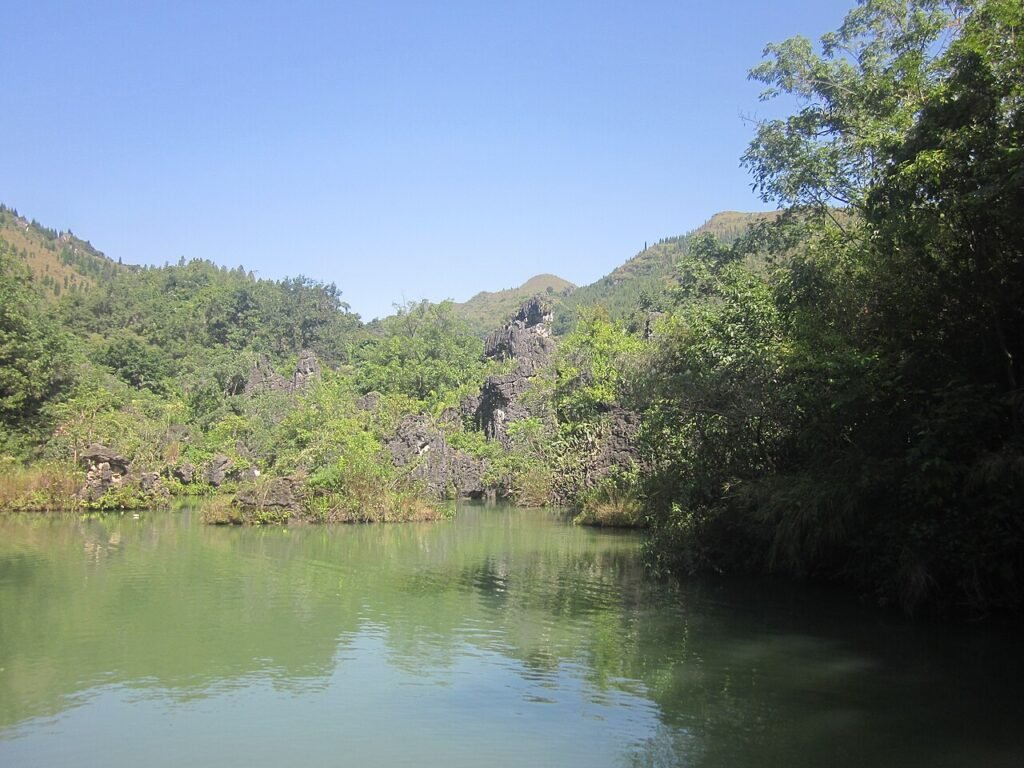
The Huangguoshu area sits in Buyei and Miao country, and the surrounding hills hold stone villages and minority-culture elements that give the west of Guizhou its character. The karst landscape itself, with limestone peaks and caves, is the geological frame for the whole province and is on show here in an accessible form. For a traveller, the value is a big, legible example of the scenery that runs through Guizhou, paired with the human layer of the villages nearby. It is a good introduction to the region before heading to the more remote southeast.
How it fits the Guizhou route
Anshun lies on the rail line southwest of Guiyang, about half an hour by high-speed train, with a road transfer of roughly forty-five minutes from the station to the falls. That makes Huangguoshu a natural western anchor for a Guiyang loop, often paired with the southeast villages as contrast. It also slots into a wider southwest route from Guilin, Chengdu or Chongqing, all of which rail into Guiyang. It does not belong on a Hunan or Fujian loop, and adding it there means long transfers for little gain.
Practical notes
- Huangguoshu is a ticketed scenic area reached via Anshun; verify current opening hours, admission and shuttle access through official sources.
- The main fall is viewable from several sides, including a cave behind the water that is the signature experience.
- The area is a cluster of eighteen waterfalls; allow time to move between the set pieces by shuttle.
- Water volume changes sharply with season, so the drama differs greatly between the rainy and dry months.
- Anshun is about half an hour by high-speed rail from Guiyang, then a road transfer to the falls; check schedules.
- Keep Huangguoshu on a Guizhou or wider southwest route, not a Hunan or Fujian loop.