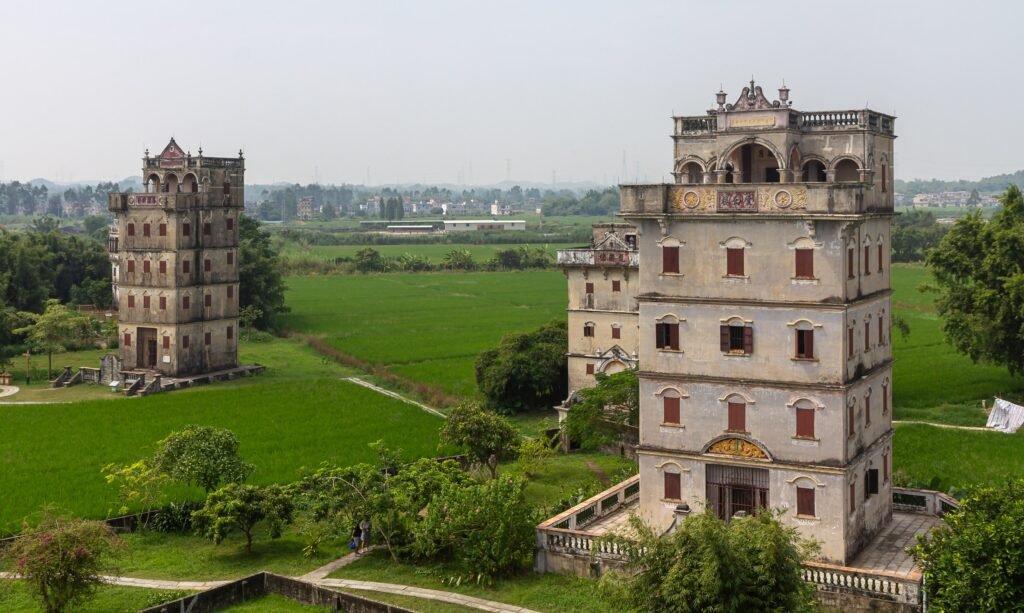
Jiangmen (江門市) lies southwest of Guangzhou and is globally known as the ancestral home of a large overseas Chinese population, but its single most distinctive asset is in the county-level city of Kaiping: the Diaolou watchtowers and villages, a UNESCO World Heritage site. Its place on a South China route is as the province’s clearest encounter with overseas-Chinese heritage and a striking form of vernacular architecture found almost nowhere else.
The character of the city
Jiangmen is a prefecture that spans a central urban district and several outlying county cities, of which Kaiping is the heritage headline. The city’s identity is bound up with emigration: over generations, people from this region travelled to Southeast Asia, Australasia, and the Americas, and many sent resources back home. That history is visible not in a single monument but in the built environment of the countryside, especially the fortified tower-houses. For a route, Jiangmen is therefore a thematic stop, best understood as the overseas-Chinese and diaspora-heritage leg of a Guangdong trip, rather than a conventional city break.
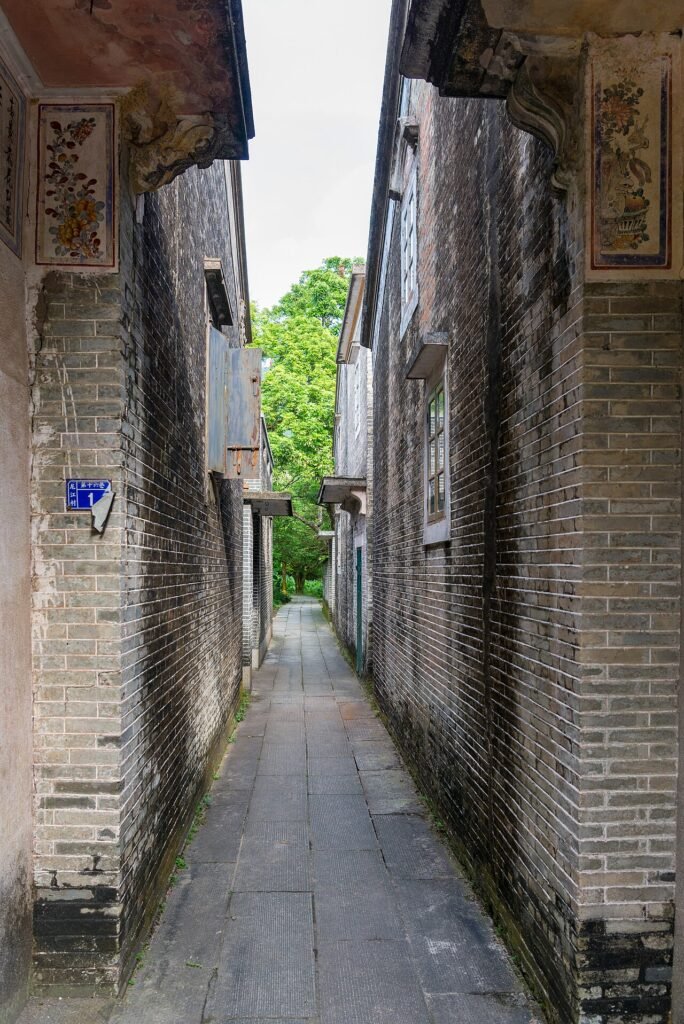
The Kaiping Diaolou
The core reason to come is the Kaiping Diaolou and Villages (開平碉樓與村落), inscribed on the UNESCO World Heritage List in 2007 as China’s first cultural site centred on overseas-Chinese heritage. The diaolou are multi-storey defensive tower-houses, built from the Ming period onward and peaking in the early twentieth century, that fuse Chinese building traditions with elements brought back from abroad: columned porticos, arched windows, and other Western details sitting atop Lingnan village forms. Several hundred remain across the Kaiping countryside, with notable clusters at Zili, Majianglong, Jinjiangli, and Sanmenli villages. The interest is architectural and historical rather than scenic, and it rewards slow driving or cycling between villages.
What the towers represent
The diaolou were built for defence against banditry and flooding as much as for residence, and their blended style reflects a specific moment when returned emigrants chose to express both security and status. The result is an unusual record of cultural exchange: not a colonial imposition but a diaspora community adapting foreign forms to local needs. For travellers interested in how global migration shaped southern China, the site is more informative than almost any museum in the region, because the evidence is the landscape itself. It also pairs well with the broader overseas-Chinese story that runs through Guangdong’s coast.
Who Jiangmen suits
Jiangmen suits travellers with a specific interest in architecture, migration history, or diaspora heritage, and those who enjoy rural driving or cycling through working villages rather than curated urban districts. It is less compelling for visitors who want dense city life, major museums, or beach and mountain scenery, because the draw is concentrated in the Kaiping countryside and is slow-paced by nature. It also works for travellers tracing family roots, since the region is a documented ancestral home for overseas Chinese communities.
Sequencing within the region
Jiangmen sits southwest of Guangzhou and is reachable by rail, placing it as a western or southwestern branch rather than part of the Shenzhen–Hong Kong corridor. A common pattern is to base in Guangzhou and make Kaiping a day trip or overnight, or to approach from the south after Zhuhai or before heading west. It does not sit naturally on a loop through Shenzhen and Hong Kong, so keep it on the western side of a Guangdong route. The travel time to the villages from the urban district means an overnight near Kaiping improves the experience.
Practical notes
- Jiangmen’s headline site is the Kaiping Diaolou and Villages, a UNESCO World Heritage site inscribed in 2007.
- The diaolou are fortified tower-houses blending Lingnan and Western architectural elements, concentrated in Kaiping county.
- Notable village clusters include Zili, Majianglong, Jinjiangli, and Sanmenli; several hundred towers remain.
- Jiangmen is known as an ancestral home of overseas Chinese, which frames the heritage theme.
- The city sits southwest of Guangzhou; treat Kaiping as a western branch, not a Shenzhen/Hong Kong through-stop.
- Allow an overnight near Kaiping to visit the villages without long daily transfers from the urban district.
- Confirm current site opening days, ticket rules, and any booking on official sources before travel.