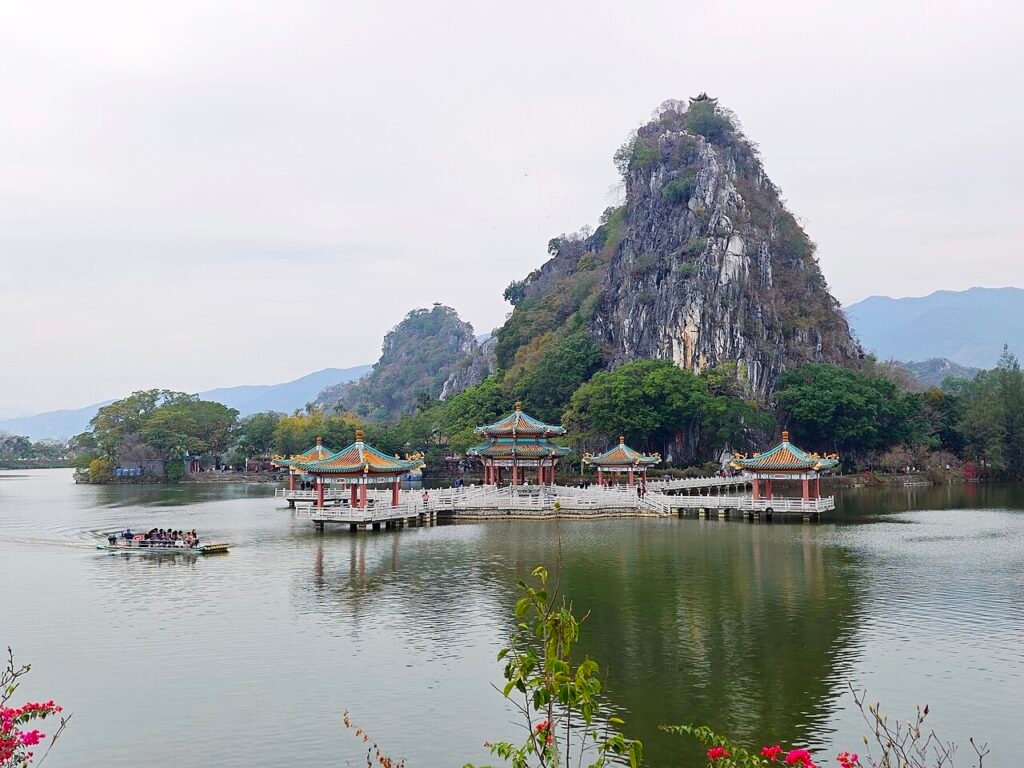
Zhaoqing (肇慶市) sits west of Guangzhou where the Xijiang (West River) opens into a landscape of karst peaks and forested mountains, and it is often treated as a fringe stop. Its case rests on two genuinely distinctive assets: the Seven Star Crags lake-and-limestone scenery and Dinghu Mountain, one of China’s oldest nature reserves, which together give a route a strong nature-and-geology day without leaving Guangdong.
The character of the city
Zhaoqing reads as a quieter, more provincial counterpoint to the delta megacities, with a compact central district and a green belt that begins almost at the city edge. The planning logic is simple: the headline sights are the Star Lake (Xinghu) scenic area, which wraps the Seven Star Crags, and Dinghu Mountain to the southeast. Both are close enough to the city to visit in a single base without long transfers, which makes Zhaoqing an efficient nature add-on for a Guangzhou-based route. It is not a place for dense urban exploration, and that is precisely its value on a packed itinerary.
Seven Star Crags and Star Lake
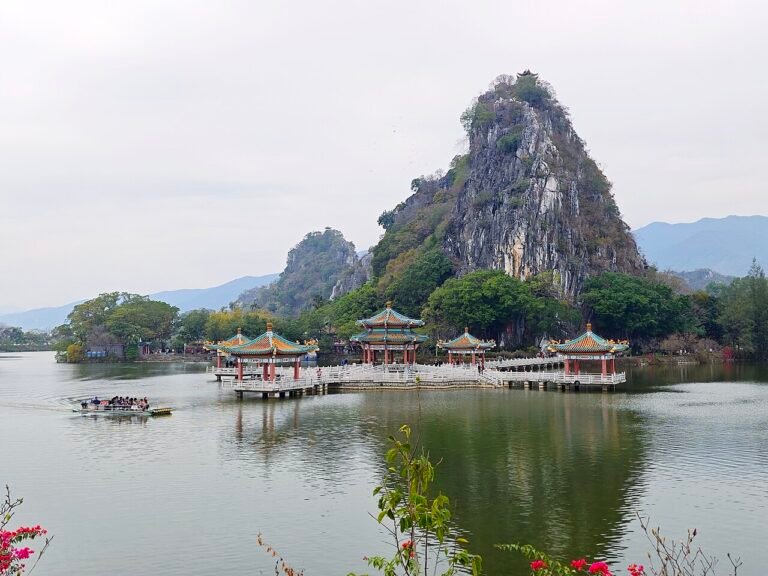
The Seven Star Crags (七星岩) are seven limestone peaks arranged across a broad lake, giving the scenery its reputation as a blend of karst drama and calm water. The area carries a long recorded history, with cliff inscriptions dating back centuries and a lakeside pagoda and garden layout that reward a slow walk or a boat ride. It is the more accessible of Zhaoqing’s two pillars: flat paths, water views, and cave and pavilion stops suit most travellers, including those who do not want strenuous hiking. For a route, it is the half-day anchor that needs no special preparation.
Dinghu Mountain
Dinghu Mountain (鼎湖山) is the other pillar and the more demanding one. It is recognised as China’s first nature reserve and forms part of a UNESCO Man and Biosphere programme, with broadleaf forest, waterfalls, and a noted Buddhist monastery, Qingyun Temple. The walking ranges from gentle riverside paths to longer climbs, so it suits a half day with flexibility built in. Its significance is ecological as much as scenic, which gives Zhaoqing a different kind of content from the delta’s temples and malls and appeals to travellers who want forest rather than city.
Who Zhaoqing suits
Zhaoqing fits travellers who have already covered Guangzhou and Foshan and want a greener, quieter leg, and those who value landscape and mild walking over monuments and shopping. It is a reasonable choice for families and older travellers because the crags are low-effort and the mountain can be taken at an easy pace. It is less suited to anyone expecting a lively nightlife or a concentration of museums; the city’s appeal is contained and natural rather than urban and endless.
Sequencing within the region
Zhaoqing lies west of Guangzhou along the Xijiang, so it works as a western extension of a Guangzhou-based route rather than a stop on the Shenzhen–Hong Kong axis. A common pattern is to base in Guangzhou and make Zhaoqing a day trip or an overnight, returning east for Foshan or continuing west toward the wider Guangxi corridor if the route is longer. It does not connect naturally with the eastern delta coast, so keep it on the western side of the plan. Rail and road links to Guangzhou are the practical backbone.
Practical notes
- Zhaoqing’s core sights are the Star Lake Seven Star Crags and Dinghu Mountain; both are close to the city and share one scenic area designation.
- Dinghu Mountain is China’s first nature reserve and part of a UNESCO Man and Biosphere programme; check current access and any reservation needs.
- The crags are low-effort and walkable; the mountain offers more strenuous options for those who want them.
- Zhaoqing sits west of Guangzhou; treat it as a western extension rather than a Shenzhen/Hong Kong through-stop.
- Allow a half day each for the crags and the mountain; an overnight makes both comfortable.
- Confirm current opening days, ticket rules, and any booking requirements on official sources before travel.
- Summer heat and humidity favour early-morning visits to both sites.