Dongguan (東莞市) sits in the dense core of the Pearl River Delta between Guangzhou and Shenzhen, and it is easy to read it only as a manufacturing city. The argument for adding it to a South China route is that it concentrates Lingnan garden heritage, a pivotal site of modern Chinese history, and accessible lakeside countryside within a short rail hop of the region’s main hubs.
The character of the city
Dongguan is not a single compact centre in the way Guangzhou or Shenzhen presents itself. It is better understood as a federation of towns, each with its own commercial life, strung along highways and rail lines. That sprawl is the main planning challenge: a visitor who tries to sample everything by bus will lose most of the day to transfers. The payoff is variety. Within one municipality you can move from a walled Qing-dynasty garden to a windswept estuary fort, then to a quiet Ming-era village and a planned lake district. For a route built around the delta’s headline cities, Dongguan works as a low-cost, low-friction extension that adds texture without demanding a long detour.
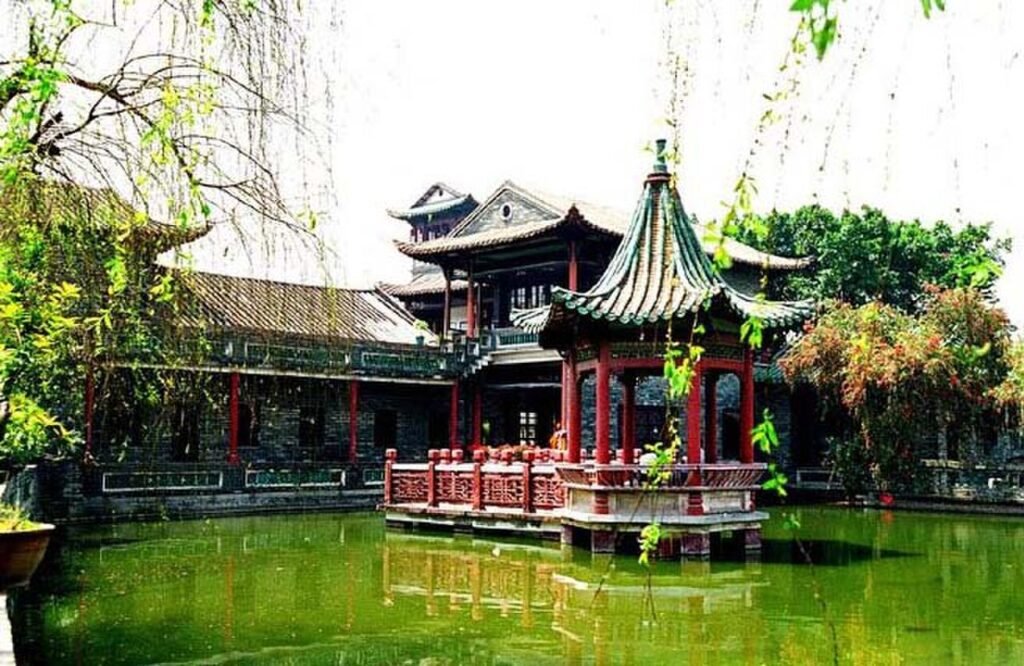
Garden heritage at Keyuan
The strongest cultural draw is Keyuan (可園), counted among the four great classical gardens of Guangdong and built during the Qing dynasty. Its interest lies less in scale than in the Lingnan interpretation of garden design: open pavilions, lattice windows, ponds, and miniature rockeries arranged for shade and breeze rather than for the enclosed formality seen further north. It is compact enough to absorb in a couple of hours, and it reads as a useful contrast to the better-known Suzhou gardens for travellers already spending time in the delta. Because it sits in the older urban core, it pairs naturally with a walk through nearby streets and a Cantonese breakfast.
Modern history at Humen
Humen (虎門), on the Pearl River estuary, is where the 1839 destruction of stockpiled opium triggered the First Opium War. The relevant sites are clustered and coherent: an opium-war museum, seaside battery fortifications such as Weiyuan Fort, and a coastal walkway that still shows the geography of the conflict. For travellers with any interest in nineteenth-century history, this is the most substantial stop of its kind in the immediate delta and it rewards a half day. The practical note is that Humen lies some distance from the garden district, so it is best treated as its own segment of the day rather than a quick add-on.
Lakeside and village counterpoints
The softer side of Dongguan appears at Songshan Lake (松山湖), a planned green belt northeast of the core with cycling paths and a lakeside promenade, and at Nanshe Ancient Village (南社古村) in Chashan, a preserved Ming–Qing settlement of grey-brick houses and ancestral halls. Neither is a headline attraction, but both fill a useful role on a route: they give a slower, walkable rhythm after the intensity of Guangzhou or Shenzhen. Songshan Lake suits cycling and picnics; Nanshe suits an unhurried afternoon of lanes and teahouses. They are best placed on a lighter day or as a buffer before a long rail transfer.
Who Dongguan suits
Dongguan is a reasonable choice for first-time delta travellers who want one example of Lingnan garden design and one modern-history site without leaving the rail network, and for repeat visitors who have already covered Guangzhou, Shenzhen, and Foshan and want a quieter, cheaper add-on. Food is a quiet strength, with Cantonese dim sum and local rice-noodle and braised-pork dishes that cost less than in the neighbouring megacities.
Sequencing within the delta
Dongguan slots between Guangzhou and Shenzhen on the high-speed line, and Humen station sits on the Guangzhou–Shenzhen–Hong Kong corridor, so it can be entered from either direction or used as a stop between Hong Kong and Guangzhou. A common pattern is a day or two drawn from Guangzhou, a short hop to Dongguan for Keyuan and Humen, then onward to Shenzhen or into the wider delta. Because the city has no commercial airport of its own, it is normally reached from Guangzhou Baiyun or Shenzhen Bao’an.
Practical notes
- Dongguan has no commercial airport; plan arrivals via Guangzhou Baiyun or Shenzhen Bao’an and allow roughly an hour of surface transfer each way.
- Humen station lies on the Guangzhou–Shenzhen–Hong Kong high-speed rail, making the city reachable from Hong Kong, Shenzhen, and Guangzhou without a transfer.
- The city is spread across towns, so pick one base (the older core near Keyuan or the Humen coast) rather than changing hotels mid-stay.
- Keyuan and the Humen forts are the two anchors; pair them on separate halves of a day because they are far apart.
- Check current opening days and any reservation requirements for the opium-war museum and forts before travelling, as these change.
- Local transport between towns is uneven; ride-hailing is the realistic default for cross-town moves.
- Summer is hot and humid, so schedule outdoor sites such as the forts and Songshan Lake for early morning or late afternoon.