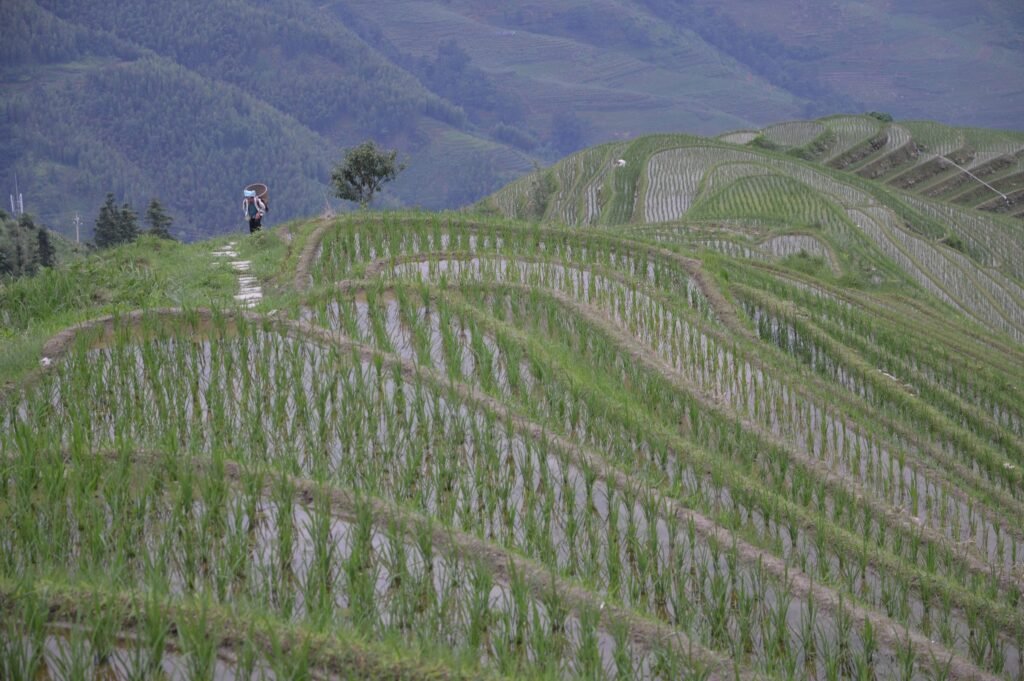
The Longji Rice Terraces (龙脊梯田, “Dragon’s Backbone”) are a carved hillside landscape in Longsheng county, north of Guilin, built up over centuries by Zhuang and Yao communities and still farmed today. For a South China route, Longji is the most reliable place to pair Guilin’s river karst with a human-shaped mountain landscape, and it rewards an overnight stay far more than a day trip because the light and the water on the terraces change through the day.
A working agricultural landscape, not a park
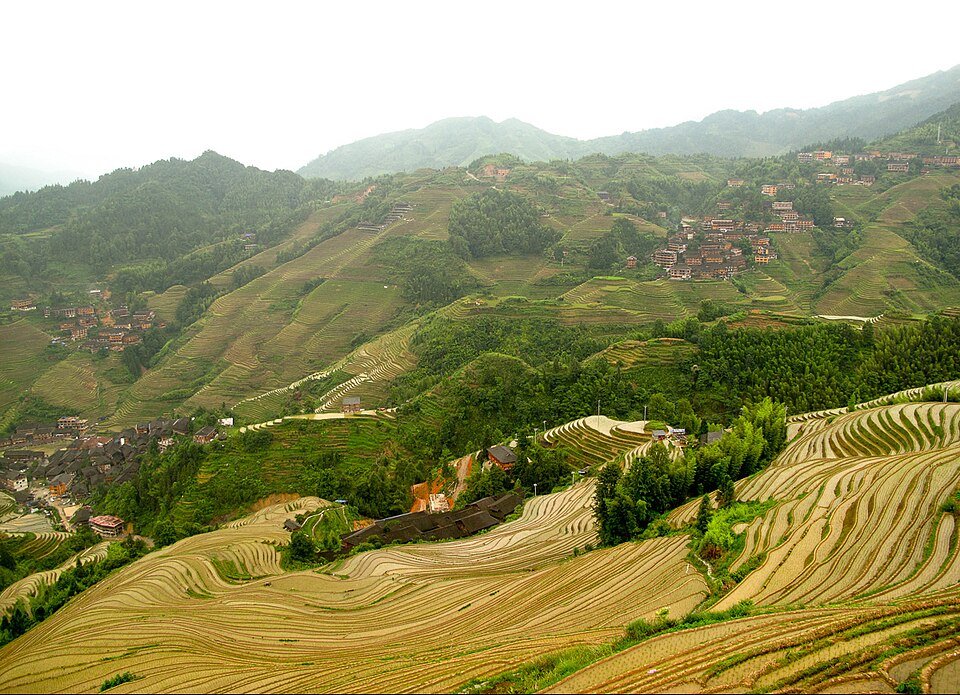
Longji is not a single viewpoint but a set of terraced valleys across several villages. The two main areas are the Ping’an Zhuang terraces (平安壮族梯田), known for the “Seven Stars with the Moon” and “Nine Dragons and Five Tigers” formations, and the Jinkeng Dazhai (金坑大寨) Red Yao terraces, broader and higher, with viewpoints such as Golden Buddha Summit (金佛顶). A third, the ancient Zhuang village (龙脊古壮寨), is quieter and older. What unites them is the logic of the terraces: narrow fields stacked up to a thousand levels, fed by a water system the villagers still maintain, with minority villages woven into the slopes.
What Longji is actually good for
The core experience is walking the terrace paths and watching the surfaces change — mirror-like after planting, green through summer, gold at harvest, and occasionally snow-dusted in winter. It is a landscape for slow movement and photography rather than for ticking sights. Village life is part of the draw: Zhuang and Red Yao communities live in the terrace settlements, and some villages are known for long hair traditions or minority dress. Cable cars exist at some viewpoints to save the climb, but the terraces are best appreciated on foot along the field edges, where the scale becomes obvious.
Who it suits
Longji suits travellers who already value Guilin-style scenery and want a mountain counterpart, plus anyone interested in rural minority culture and landscape photography. It fits couples and steady walkers, and families if the children can manage paths. It is less good for travellers with limited mobility (the villages sit up steep slopes, and the best views are a climb or a cable car away) and for anyone who expects nightlife or a town centre. The reward is quiet and visual, not entertainment.
The minority-village dimension
The Zhuang and Yao presence is not decorative. The terraces were built and are kept by these communities, and the villages are where you eat, sleep, and walk. Staying in a village guesthouse is what separates a real Longji visit from a roadside photo stop. The trade-off is basic mountain accommodation and early dark; the gain is mist over the fields at dawn, which is the image most visitors actually come for. Respect for village routines and private space matters more here than at a managed scenic city.
How it fits the wider southern route
Longji sits north of Guilin, on the road toward Longsheng and the Hunan border, so it chains naturally onto a Guilin or Yangshuo stay: Guilin → Longji → (back to Guilin or north onward). It is too far west to pair cleanly with Nanning or Beihai in one pass, and it has no place in a Fujian route. Because it is a half-day transfer from Guilin, the usual pattern is to add one or two nights to a Guilin-based plan rather than to build a trip around Longji alone.
Practical notes
- Longji is reached from Guilin by road; transfer time is meaningful, so confirm current options via official sources.
- The two main zones (Ping’an and Jinkeng Dazhai) are separate; choose one to stay in or allow extra time to split your nights.
- Terrace colour follows the farming calendar: flooded spring, green summer, gold harvest, rare snow in winter — verify the current stage before booking.
- Village accommodation is basic and mountain-based; book through current official or verified channels.
- Cable cars at some viewpoints reduce climbing but are weather-dependent; check operation locally.
- Carry cash or a China-compatible payment app, as small villages may not take foreign cards.
- Best light is early morning and late afternoon; plan to be in the village overnight rather than day-tripping.