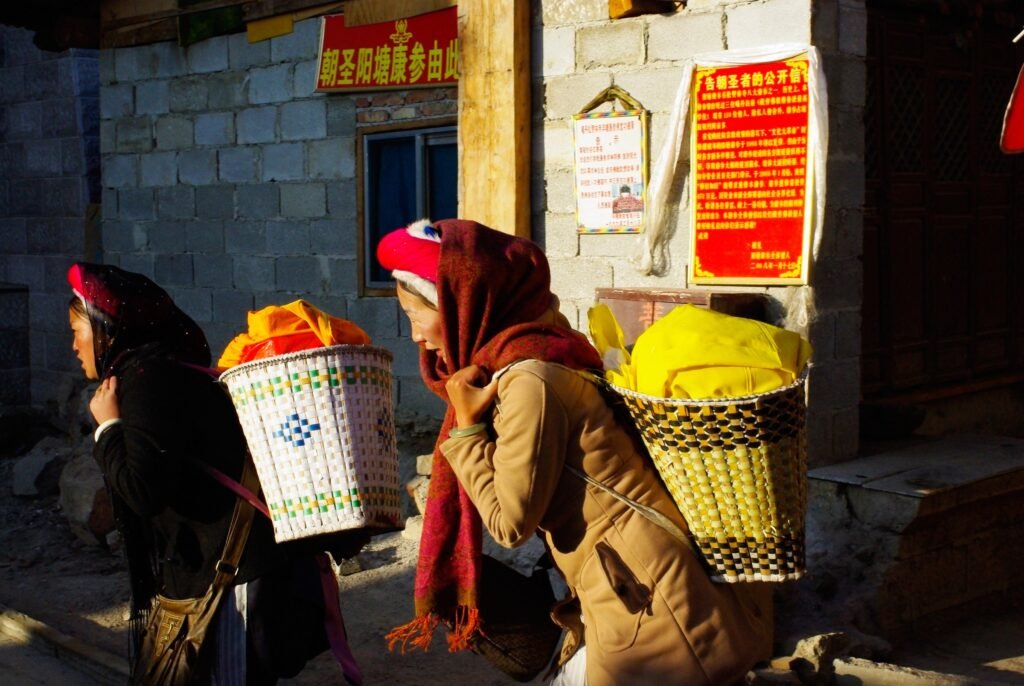
Shangri-La sits at the southeastern edge of the Tibetan Plateau in northwestern Yunnan, a high, cold, Tibetan-cultural counterpoint to the temperate old towns of Dali and Lijiang. It earns its place on a South China route for travellers who want altitude, monastery architecture and open grassland rather than another Han-style lane-and-courtyard town.
What Shangri-La actually is
The city was known as Zhongdian until 2001, when it adopted the name made famous by James Hilton’s novel. Administratively it is the seat of the Diqing Tibetan Autonomous Prefecture, and the population and street life are markedly Tibetan in character. The centre sits at roughly 3,200 to 3,300 metres, which is the single fact that shapes every decision about visiting: this is not just another Yunnan town, it is a plateau town where the body notices the elevation.
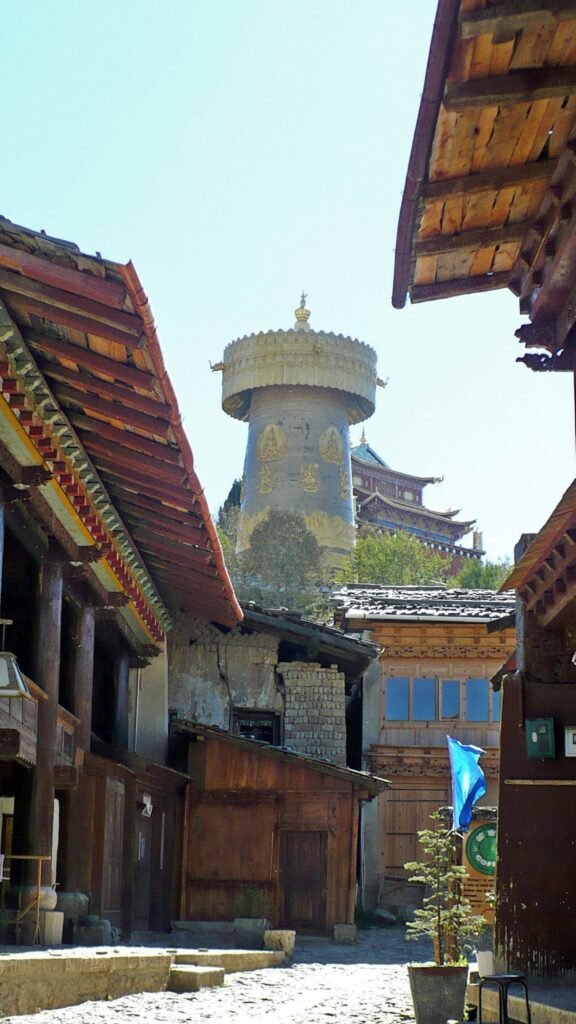
The cultural draw: Tibetan plateau life
The two anchors are Dukezong Ancient Town and Songzanlin Monastery. Dukezong is one of the oldest Tibetan settlements in China, with more than 1,300 years of continuous history; its stone lanes, prayer-wheel and hillside temples make it the natural lodging base. Songzanlin, often called the “Little Potala Palace,” is the largest Tibetan Buddhist monastery in Yunnan and the most photographed landmark in the region. Both are genuine, working cultural sites rather than stage sets, and the etiquette of entering monasteries — covering heads, not pointing at statues, asking before photographing monks — applies here.
The natural draw: lakes, meadows and snow
Beyond the town, Pudacuo National Park holds alpine lakes and boardwalk meadows at around 3,500 metres, and Napa Lake is a seasonal wetland that becomes a grazing grassland in the dry season and a shallow lake in the wet. Further west, the Meili Snow Mountain range and its main peak Kawagebo (about 6,740 metres) are the prize for travellers with extra days, best viewed at sunrise from Feilai Temple. These are big, quiet landscapes, and they reward patience with weather more than they reward ticking boxes.
Who it suits
Shangri-La suits travellers who are comfortable with altitude and with a slower, colder rhythm. It is excellent for those interested in Tibetan Buddhism, plateau ecology, or simply a visual change from the green south. It is a poor fit for anyone who reacts badly to elevation, for tight schedules that cannot absorb a rest day, or for visitors expecting the mild climate of Dali or Kunming. Children and older travellers can manage it, but only with a planned acclimatisation day.
How it fits a northern Yunnan route
Shangri-La is the western terminus of the classic Kunming → Dali → Lijiang → Shangri-La spine. It is best reached after Lijiang, both for the high-speed rail connection and because the gradual climb from 2,400 metres at Lijiang to 3,300 metres at Shangri-La is gentler on the body than arriving directly by air. Treat it as the high point of the route in every sense, and leave room to drop back down to Lijiang or fly out via Diqing Shangri-La Airport rather than pushing further west without preparation.
Beyond the core sights, the value of Shangri-La on a route is as a contrast. Most Yunnan travel stays in the temperate, Han-and-Bai world of the lake towns; Shangri-La breaks that pattern with Tibetan language, architecture and altitude, and that contrast is what makes the northern loop feel like more than a sequence of pretty old towns. The cost is logistics — you are at the end of a long rail line and at real elevation — but for travellers building a first Yunnan itinerary, the plateau stop is the one that tends to be remembered longest. Plan it as the deliberate high point rather than an optional extra.
Practical notes
- Altitude is the defining risk: rest on arrival, avoid alcohol on day one, and watch for altitude sickness.
- Dukezong is the practical place to stay; the new city has newer hotels if you prefer.
- Pudacuo and Songzanlin are the core sights; Meili Snow Mountain needs at least two extra nights.
- Carry layers and sun protection year-round — plateau sun and temperature swings are real.
- Confirm all entry, shuttle and transport pricing with current official sources before travel.
- If flying in directly, allow extra acclimatisation time compared with arriving by train from Lijiang.