Jianshui is a county town in southern Yunnan, about 220 kilometres south of Kunming, that preserves a Ming-and-Qing era core better than almost any other settlement in the province. It earns a place on a South China route for travellers who want Confucian and merchant heritage, quiet streets and local craft, without the crowds of Yunnan’s famous old towns.
What Jianshui actually is
Jianshui, historically known as Lin’an, was a garrison and trading town on the route toward Vietnam and grew into a cultural centre for the region. Its old town survived the twentieth century relatively intact, with gates, temples, Confucian architecture and merchant compounds still in place. The feel is scholarly and settled rather than theatrical: this was a place that produced examination scholars for centuries, and that seriousness still reads in the layout of its public buildings.
The scholarly draw: the Confucius Temple
The Jianshui Confucius Temple, founded in 1285, is one of the largest Confucian temples in China, second in scale only to the one in Qufu. It is laid out on a long north–south axis with gates, pools and halls, including a hall of great achievement and a large collection of stone steles. For a visitor, it is a calm, tree-shaded complex that explains the town’s self-image as a centre of learning, and it is the single most distinctive sight Jianshui offers. Treat it as a place to walk slowly rather than a quick photo stop.
The merchant draw: Zhu Family Garden and the gates
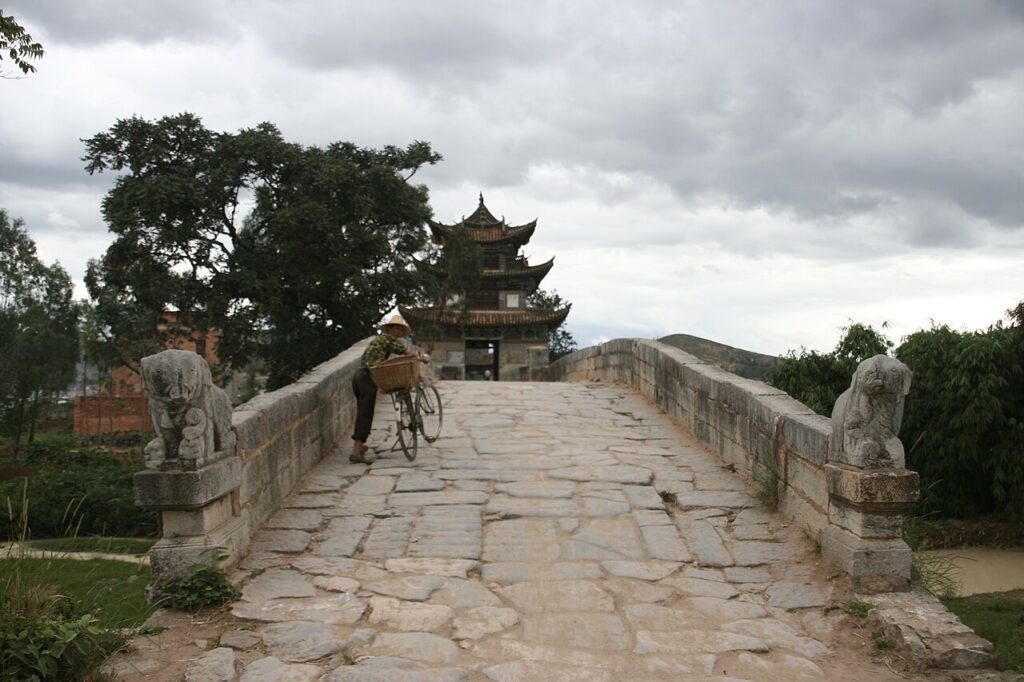
The Zhu Family Garden is a late-Qing merchant compound of linked courtyards, ponds, ancestral halls and a private theatre, built by a wealthy local family and now restored. It gives a clear picture of how a prosperous household was organised. At the edge of the old town, the Chaoyang Gate Tower is a surviving Ming gate that predates Beijing’s Tiananmen, and the Twin Dragon Bridge carries seventeen arches across the river a few kilometres out. Together these show Jianshui’s confidence as a walled, literate town rather than a village.
Craft, food and the slow railway
Jianshui is known for purple pottery (Zitao), made from local clay with a dark, lustrous finish, and workshops around the old town sell teapots and jars. The food is a draw in its own right: clay-pot chicken, grilled tofu and local rice noodles are everyday street fare. A narrow-gauge tourist train, running on remnants of the old Dian-Vietnam railway, connects the town to Tuanshan village, a preserved cluster of nineteenth-century houses, and the slow ride is part of the experience rather than just transport.
Who it suits
Jianshui suits travellers interested in history, architecture and craft, and those who prefer a working town to a curated resort. It is good for a relaxed overnight after Kunming, and for visitors who have already seen Dali and Lijiang and want a quieter, more studious Yunnan. It is a weak fit for anyone needing dramatic natural scenery as the main event, since the appeal here is built and cultural rather than mountainous.
Jianshui also works as a counterweight to the more performed heritage towns elsewhere in China. Because it is still a county seat with ordinary life running through it, the Confucius Temple is used rather than merely displayed, and the old lanes are residential, not a row of shops. For a planner this means the visit is robust to crowds — there is no single bottleneck that ruins the day — and it pairs well with a slower travel style. Visitors who enjoy wandering without a fixed list will get more from Jianshui than those who treat it as a checklist of named sights, because the town’s appeal is cumulative rather than concentrated.
Practical notes
- Jianshui is a living county town; the sights are spread through the old core and just outside it.
- The Confucius Temple and Zhu Family Garden each charge admission; confirm current prices with official sources.
- The narrow-gauge train to Tuanshan is a timed excursion — verify the schedule in advance.
- Jianshui purple pottery is the notable craft; buy from established workshops if provenance matters.
- The town is walkable, but distances to the bridge and Tuanshan need local transport.
- Treat all ticketing and train times as variable; check current official sources before travel.