Tengchong lies in the far west of Yunnan, close to the Myanmar border, on a volcanic field that is still geothermally active. It earns a place on a South China route for travellers who want geology, hot springs and a quiet merchant town, rather than the plateau scenery or minority villages that define the province’s better-known stops.
What Tengchong actually is
Tengchong is a county-level city built on a volcanic landscape, part of the Tengchong Volcanic Geothermal National Geological Park. Unlike the limestone karst of Guizhou or the granite peaks of Jiangxi, this is basalt country: cones and craters rise out of farmland, lava has been cut by rivers, and steam and boiling water emerge from the ground in several places. The town itself sits at a moderate elevation, around 1,600 metres, so altitude is not a concern here the way it is at Shangri-La. The character is frontier — a place where China meets Southeast Asia across a long, porous border.
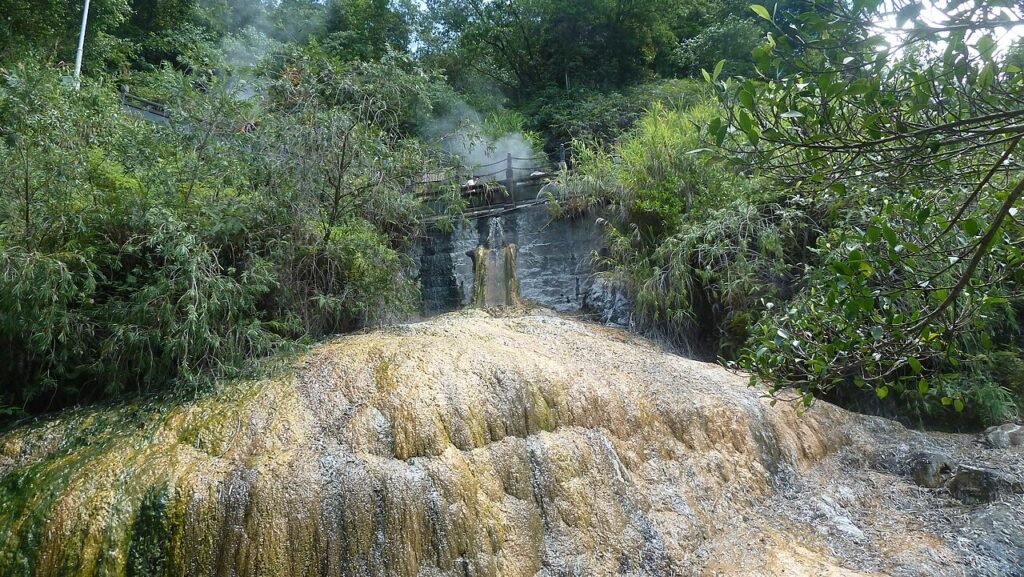
The geothermal and volcanic draw
The headline natural sights are the Rehai (Hot Sea) geothermal area and the Volcano Park. Rehai concentrates boiling springs, bubbling mud and steam vents, with a signature pool hot enough to cook eggs — a natural curiosity rather than a bath. The Volcano Park holds well-formed cones that can be climbed in an hour or two, some served by a cable car, with forested craters and basalt flows between them. The two halves — boiling ground and quiet cones — make Tengchong distinct from anywhere else on a typical Yunnan itinerary.
The cultural draw: Heshun Ancient Town
A few kilometres from the city, Heshun is a preserved merchant village built by men who traded and emigrated across the border into Myanmar. The result is a compact hillside settlement of courtyard houses, ancestral halls, temples and a noted library founded in the 1920s, with architecture that mixes Chinese planning and Southeast Asian or European detail brought home by returning traders. It is quieter and less commercial than Yunnan’s headline old towns, and it gives the visit a human, historical dimension that balances the geology.
Who it suits
Tengchong suits travellers who like unusual landscapes, warm-water relaxation and borderland history. It is good for people who have already done Dali and Lijiang and want something different, and for those who appreciate a slower, less crowded town. It is a weak fit for anyone on a tight first-visit Yunnan loop who must choose between highlights, and for travellers who dislike long transfers, because western Yunnan is far from the provincial centre.
How it fits a Yunnan route
Tengchong is a western outlier. It connects most logically to Dali, either as a long drive or a flight, and it can extend toward Ruili and the border if that interests you. It does not sit naturally on the Kunming–Dali–Lijiang–Shangri-La spine and should be treated as a separate western branch rather than a waypoint. Because getting there takes effort, it rewards at least two nights so the transfer time is not the dominant part of the visit.
Tengchong also carries a layer of 20th-century history that some visitors value as much as the geology. The Burma Road and the retaking of the town in the Second World War are commemorated at local cemeteries and museums, and for travellers interested in the China–Myanmar theatre this gives the visit a serious dimension absent from the hot-spring towns elsewhere in Yunnan. It is not a primary draw for most, but it is a reason the city rewards more than one day. Weigh it against the geothermal and Heshun time when you allocate your nights, rather than treating history as an afterthought that gets squeezed out.
Practical notes
- Tengchong has an airport with flights from Kunming; road access from Dali is long — verify current routes.
- The town is at moderate altitude (~1,600 m), so elevation is not the issue it is further north.
- Heshun is the atmospheric base; the new city is more functional but less interesting.
- Border proximity means carrying your passport; some nearby zones may need permits — check current official sources.
- Geothermal areas are hot and uneven underfoot; follow marked paths and barriers.
- Treat all entry, cable-car and bathing pricing as variable; confirm with current official sources.