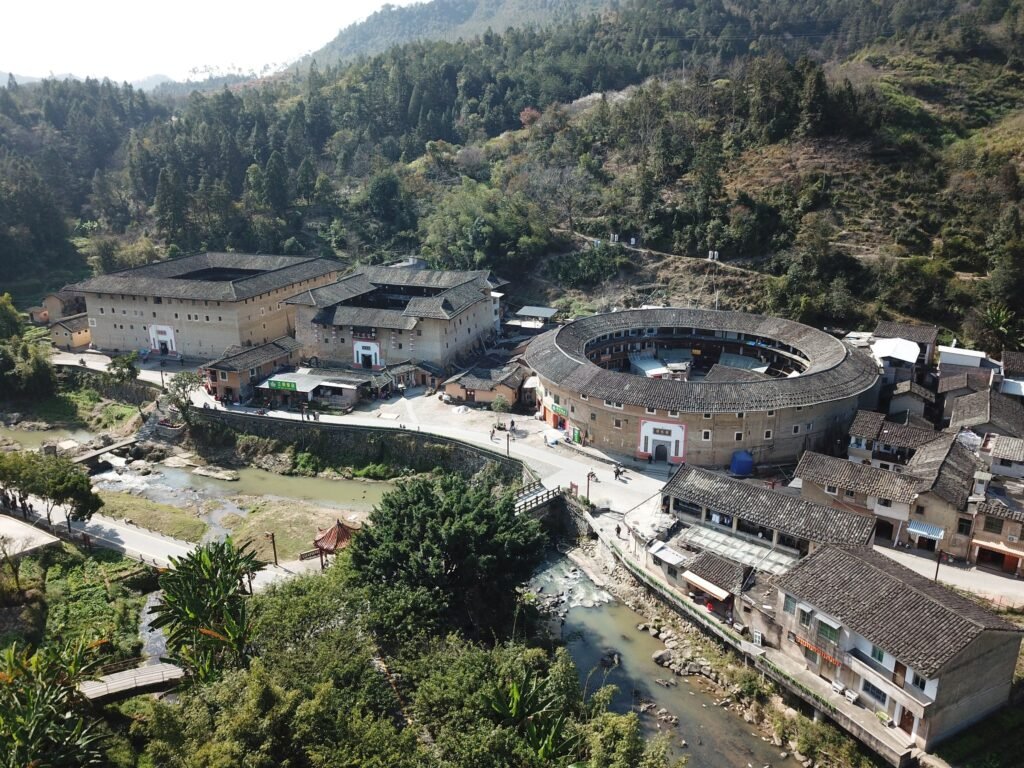
Yongding (永定区), in the mountainous west of Fujian, holds the core of the Hakka earthen towers known as Tulou (土楼), built of rammed earth into vast round or square communal homes and inscribed as a UNESCO World Heritage site in 2008. For a South China route, Yongding is the rural counterpart to Quanzhou’s port heritage and Xiamen’s coast: a place to see how whole clans lived inside a single fortress-like building, set among terraces and streams.
Earthen towers built for a clan
The Tulou are not houses in the ordinary sense but enclosed communities. A single round tower such as Chengqi Lou (承启楼, the “King of Tulou”) rings hundreds of rooms around a central ancestral hall, with families stacked on multiple floors and a shared courtyard at the middle. The form answered defensive need and collective living: thick earth walls, few outer windows low down, and a self-contained well and store. What looks from outside like a fort reads from inside as a village, and that double nature is the real subject of a visit. Yongding’s “five celebrated towers” — Chengqi, Zhencheng, Zhenfu, the Nanxi cluster, and Chuxi — each show a different shape and period.
What Yongding is actually good for
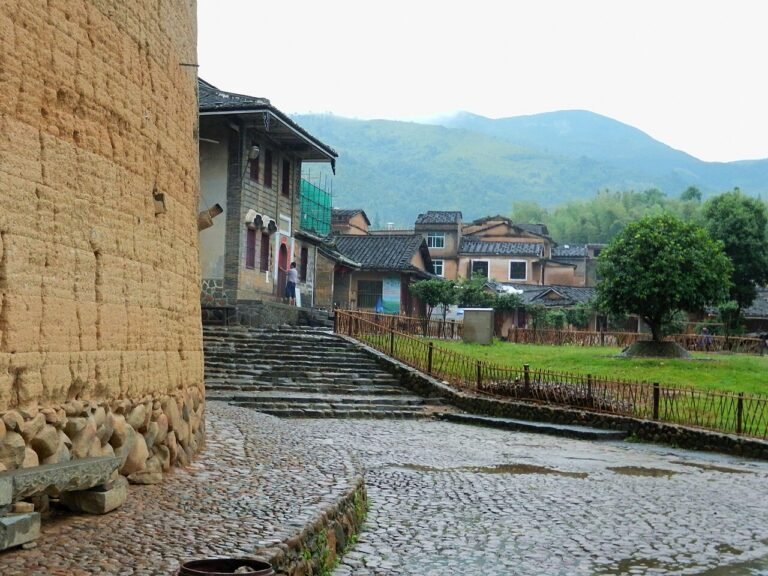
The core experience is walking inside a inhabited tower and reading its layout: the ring of rooms, the central shrine, the staircases, the way light falls on the earth walls. Zhencheng Lou (振成楼, the “Prince”) is the showpiece, a double-ring round tower with a partly Western styling inside, while Chuxi (初溪) pairs towers with terraced fields for the most scenic setting. Beyond architecture, the draw is Hakka culture — food, building craft, and the logic of clan living — and the slow mountain pace. It is a landscape of buildings, best taken on foot between villages, not from a car window.
Who it suits
Yongding suits travellers who value vernacular architecture, rural China, and a slower rhythm, and it pairs naturally with a Fujian route after Xiamen and Quanzhou. It fits photographers (round towers against terraces, mist, and lantern light) and culturally curious visitors; it is less good for nightlife seekers or those with limited mobility, since the villages sit up slopes and tower interiors have steep stairs. Families can enjoy it if children can manage paths and steps. The reward is atmosphere and craft, not spectacle.
The Hakka story
The Tulou exist because the Hakka, a Han subgroup who moved south over centuries, built defensive communal homes in mountainous Fujian. The earth-wall technique, the clan courtyard, and the shared storage were practical responses to terrain and insecurity, and they produced a building type found almost nowhere else. Understanding this turns a photo stop into a read of history: each tower is a small society, and the cluster is a diaspora’s answer to a hard landscape. The planning point is to spend time inside at least one tower rather than only viewing from a roadside platform.
How it fits the wider southern route
Yongding is the inland western anchor of a Fujian loop, normally reached from Xiamen or Quanzhou and often combined with the neighbouring Nanjing Tulou (田螺坑, Yunshuiyao) to the east. A clean shape is Xiamen → Quanzhou → Yongding → (Nanjing) → back via Xiamen or north. It has no place in a Guangxi route; the provinces are separate trips. Yongding works as a one-to-two-night rural stay, usually with a village guesthouse, and it balances the coastal and urban Fujian stops with mountain quiet.
Practical notes
- Yongding is reached via Longyan by rail, then road to the tulou villages; confirm current rail and bus options via official sources.
- The “three clusters and two towers” (Hongkeng, Gaobei, Chuxi, Zhenfu, Yanxiang) are spread; choose a base rather than trying to see all in a day.
- Stay one to two nights in or near a village to experience the towers at dawn and dusk.
- Best months are spring and autumn; summers are hot and the mountains are typhoon-exposed.
- Village guesthouses are basic; book through verified channels and reconfirm.
- Carry a China-compatible payment app or cash; small villages may not take foreign cards.
- Yongding pairs with Xiamen and Quanzhou in Fujian, not with any Guangxi destination.