Xiapu (霞浦縣) is a coastal county in northeastern Fujian, administered by the city of Ningde, and it is best known among travellers for one specific thing: its tidal flats. Where most South China routes are built around mountains, old towns and minority villages, Xiapu offers a low, horizontal landscape of mudflats, seaweed farms and fishing boats that changes with every tide. It is a destination for people who want one genuinely different visual register in an otherwise inland-heavy itinerary, and it is worth understanding before deciding whether the detour fits.
What Xiapu actually is
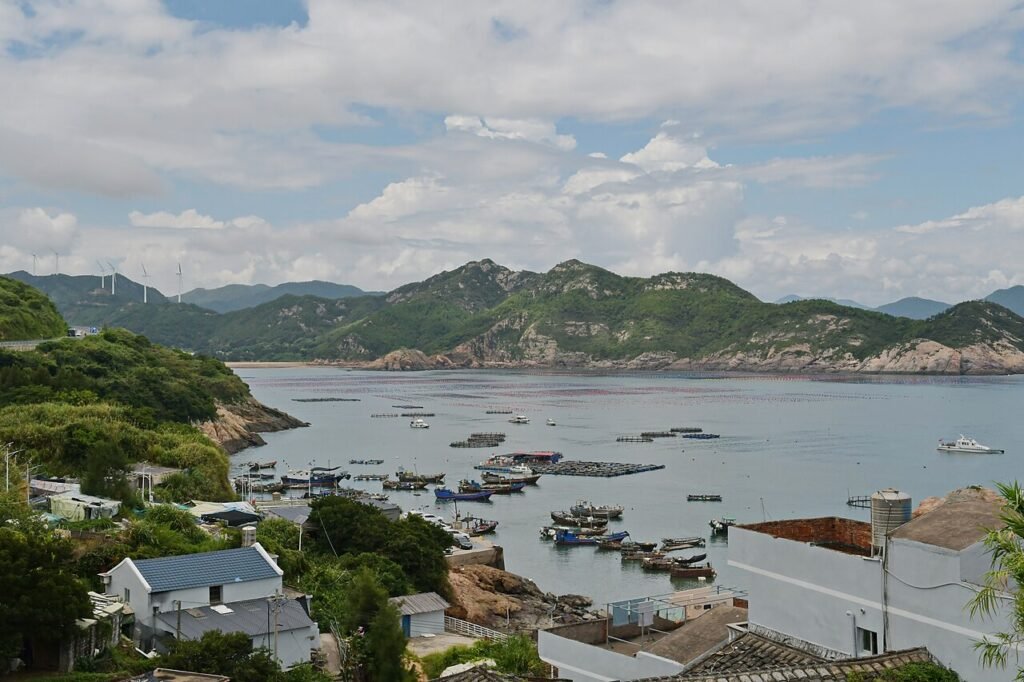
The county sits on the East China Sea with a long, deeply indented coastline and a wide band of intertidal mudflat. The flats are a working seascape rather than a constructed attraction: local households farm laver and oysters, set out raft aquaculture, and run small boats through channels that drain and refill twice a day. The appeal is the pattern this produces, rows of bamboo poles, nets and boat tracks across wet sand that read almost like an ink painting when caught in the right light. Photography is the main reason visitors come, but the same coastline supports seafood eating and ordinary village life that is worth a slow afternoon even for non-photographers. The county is sometimes described in travel media as having among the most concentrated tidal-flat scenery in the country, which is why it draws a dedicated photography crowd rather than general tourists.
Who it suits, and who it will not
Xiapu suits travellers who already enjoy landscape photography, birdwatching, or simply standing still and watching light move. It is also a good counterweight for a Fujian trip that might otherwise be all temples and old streets. It does not suit people who want a packed sightseeing list, polished visitor centres, or nightlife. The county town itself is functional rather than charming, and the recognised views are scattered along the coast at points such as Beiji, Xiaohao and Dongbi, each with its own best tide and light. You trade convenience for atmosphere, and you should expect to plan around nature rather than around opening hours.
The rhythm of the seasons
The flats look different across the year, and the timing of a visit matters more here than at most stops. Late winter and early spring bring clear, low light and the start of the laver season; summer carries dramatic clouds and typhoon-influenced skies but also heat and unpredictability; autumn is the laver harvest, with the most active human footage on the mud; winter is calm and quiet, with fewer visitors and a cleaner, colder palette. None of these is wrong, but they produce different photographs and different moods, so the choice should follow what a traveller wants to see rather than a generic best month. The point is that Xiapu is not a place with one ideal window, it is a place whose character rotates with the calendar.
How it fits the wider Fujian route
Xiapu is most logically paired with the coastal cities to its south. Fuzhou is roughly an hour away by high-speed rail and Xiamen is reachable in a few hours, so a traveller can treat Xiapu as a northern Fujian extension of a Xiamen to Fuzhou coastal loop rather than a detour. It does not connect naturally to the Hunan or Guizhou legs of a South China plan; if those are the priority, Xiapu belongs to a separate Fujian segment. The practical question is whether a route already commits to Fujian, because adding Xiapu purely for variety usually means flying or training into Ningde or Fuzhou first, then branching out to the coast.
A note on expectations
The single biggest mistake is to assume the postcard views appear on demand. They depend on tide tables, weather and being at the right point at the right hour, often before sunrise. Visitors who expect a scenic spot they can drive up to at noon will be disappointed. Visitors who build a day or two around the tide schedule, and who treat the mudflat points as a series of short dawn and dusk visits, tend to leave satisfied. Xiapu rewards patience and an early alarm more than almost any other stop on a South China route, and it is honest to say it is a specialist’s destination rather than a crowd-pleaser.
Practical notes
- Xiapu has its own high-speed rail station with services toward Fuzhou, Wenzhou and Xiamen; confirm current schedules and journey times through official rail sources before booking.
- The recognised photography points are spread along the coast and are reached by local road, so plan movement by the tide rather than by a fixed daily plan.
- There are no regular passenger ferry services along this coast, so travel between points is by road; a driver or rideshare for half days is the usual arrangement.
- Seasonal light and tide are the real attraction, so check tide tables and local sunrise times for your dates rather than assuming good conditions.
- The county town is a base, not a highlight; stay for coastal access, not for the town itself.
- Entry to individual small sites and any organised experiences should be verified for current opening and ticketing through official channels.