Zunyi (遵義市) is a city in northern Guizhou that earns a place on a South China route through modern history rather than scenery. It is where the critical 1935 conference of the Chinese Communist Party was held, and the preserved site is the reason travellers stop. For a Guizhou itinerary built around Guiyang, Huangguoshu and the Miao villages, Zunyi is the historical counterweight that explains the provincial and national story a visitor would otherwise miss.
What Zunyi actually is
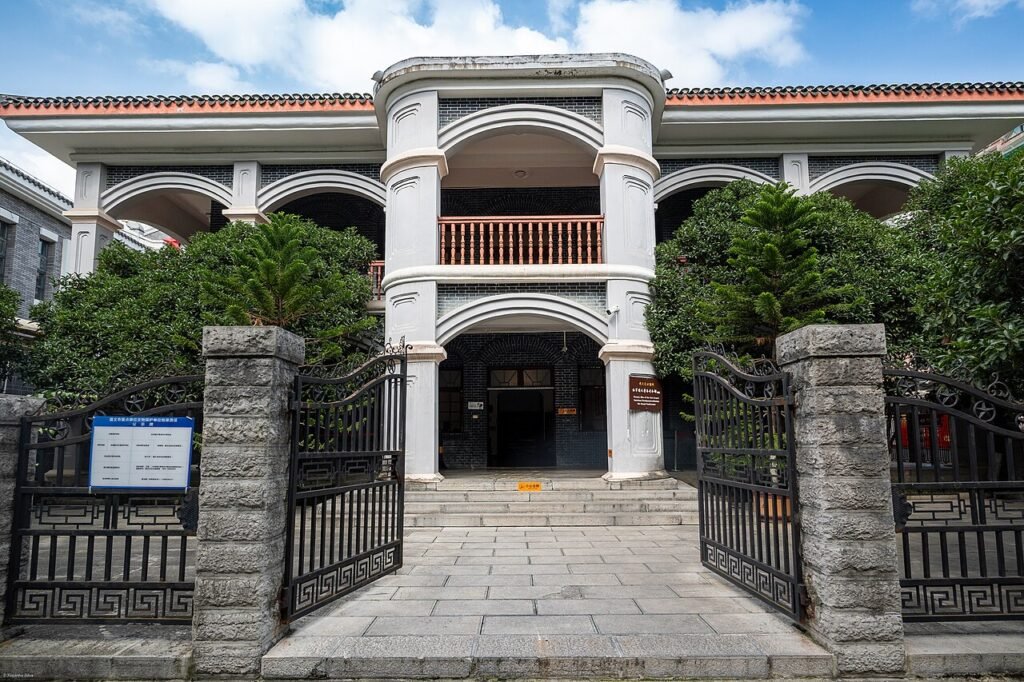
The city is a regional centre in northern Guizhou with a long civilian history, but the visitor focus is the Zunyi Conference Site, a two-storey building on Ziyin Road in the old city. The structure was originally a private residence and is a blended Chinese-Western brick-and-timber building of the early Republican period. It is presented as the place where, over three days in January 1935, the party’s leadership was reshaped at a decisive moment in the Long March. Around the main building, a set of associated revolutionary sites and a large exhibition hall tell the broader story, and together they form a contained memorial district.
Who it suits
Zunyi suits travellers with an interest in modern Chinese history, in how the country presents its revolutionary period, or in adding a narrative layer to an otherwise scenic Guizhou trip. It pairs well with Guiyang and works as a northern break before heading toward the mountains and villages of the southeast. It is not a scenic or minority-culture stop, so travellers whose plan is purely about landscapes and villages may treat it as optional. The visit is more meaningful with light background reading, because the site tells a curated official account rather than a contested one.
The conference and its weight
The 1935 meeting is the reason the city matters. The exhibition frames it as a turning point that established a new leadership at a moment of extreme military difficulty, and the main building preserves the meeting room as a fixed tableau. For Chinese visitors this is a key heritage site; for foreign visitors the interest is interpretive, seeing how a single room is staged as a national pivot and what that reveals about official memory. The associated sites, including former residences and support offices of the period, extend the story across a few blocks, so the visit is walkable and contained.
A second Guizhou thread
Zunyi also sits in the heart of Guizhou’s famous liquor country, since the celebrated Maotai is produced in a town to the west of the city. That is a regional-economy point rather than a tourist programme, but it explains why Zunyi appears on broader Guizhou routes and why the city has a particular standing in the province. The surrounding region also produces other well-known provincial foods, which gives Zunyi a place in Guizhou’s culinary geography alongside its history. Travellers interested in food and drink culture will note the connection, even if the distilleries themselves are a separate excursion and not part of the conference visit.
How it fits the Guizhou route
Zunyi lies on the rail line north of Guiyang toward Chongqing, roughly an hour from the provincial capital by high-speed train. That makes it a natural northern add-on to a Guiyang-based plan, or a first stop for travellers coming from Chongqing. It does not connect to a Hunan or Fujian loop in any natural way, so keep it inside the Guizhou segment. For a route that is otherwise waterfalls and villages, Zunyi supplies the historical spine without requiring a long detour.
Practical notes
- The Zunyi Conference Site is the core stop; verify current opening days and any reservation rules through official sources.
- The site is a preserved early-twentieth-century building presented as a fixed historical tableau, not a recreated set.
- Associated revolutionary sites and a large exhibition hall extend the visit across a few blocks on foot.
- Zunyi is on the rail line north of Guiyang toward Chongqing, about an hour by high-speed train; check schedules.
- The city is also the gateway to Guizhou’s liquor country, a regional note rather than a tourist programme.
- Approach the visit as modern history and official memory, with a little background reading for context.