Xijiang Miao Village, known in full as Xijiang Qianhu Miao Village (西江千戶苗寨), is in Leishan County in the Qiandongnan Miao and Dong Autonomous Prefecture of southeastern Guizhou. It earns a place on a South China route as the most concentrated example of Miao hill-village life that a traveller is likely to see, a stacked settlement of timber stilt houses above terraced fields and a dividing river. For a Guizhou plan built around Guiyang and Huangguoshu, Xijiang is the cultural anchor of the southeast.
What Xijiang actually is
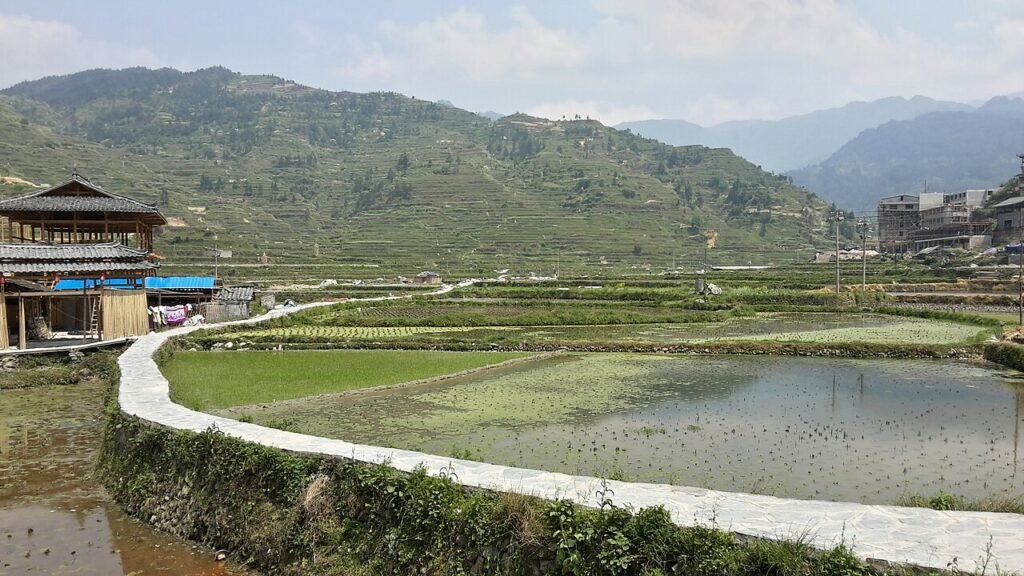
The village is described as the largest Miao settlement in the country, with well over a thousand households and a population that is overwhelmingly Miao. The buildings are traditional stilt houses, called diaojiaolou, built up the hillside in tiers so that the whole slope reads as a single wooden settlement. A river, the Baishui, runs through the middle and divides the village, with covered wind-and-rain bridges linking the banks. Terraced fields climb the surrounding hills. The result is a rare combination of scale and coherence: not a single photo point but a lived-in hillside community that you walk through rather than observe from afar.
Who it suits
Xijiang suits travellers interested in minority culture, in photography of built landscape, or in seeing how a traditional village operates at scale. It works as a contrast to the natural spectacle of Huangguoshu and the history of Zunyi, supplying the human layer of a Guizhou route. It is less suited to travellers who want untouched isolation, because the village is developed and commercialised, with a busy main street and evening light displays. The honest framing is a major, managed heritage site, not a hidden hamlet, and visitors who accept that tend to enjoy it more.
The cultural layer
The village keeps several living traditions. The twelve-course welcome wine, offered at the entrances, is a set greeting rather than a casual drink, and the lusheng reed-pipe dances in the square are performed at fixed times. The Gage ancient alley holds smaller craft demonstrations, including silver work and embroidery, and a Miao museum on the hillside covers dress, tools and history. For a visitor, the value is in seeing these practices in one place and understanding the agricultural rhythm the terraces represent. Reading the customs as staged-but-real helps set expectations about what is performance and what is daily life.
Scenery and the seasons
The settlement is at its most striking at dusk, when the hillside lights come on and the wooden tiers read as a single glowing mass, which is the image most visitors come for. Daytime rewards walking the alleys, the river bridges and the terrace trails away from the commercial street. Spring brings green terraces and flowers, autumn the harvested gold, winter a quieter, colder village. There is no fixed festival date that reliably improves the visit, so the choice is mostly about weather and crowd comfort, with the evening view worth planning around regardless of season.
How it fits the Guizhou route
Xijiang lies southeast of Guiyang, reached via Kaili, and it pairs naturally with Huangguoshu as the cultural half of a Guizhou loop. A clean shape is Guiyang, then the falls to the west, then southeast to Xijiang and the wider Qiandongnan area, or the reverse. It does not sit on a Hunan or Fujian loop, and adding it there means long transfers. Within Guizhou, its position is convenient, and a traveller already committed to the province can include it without real cost to the route, using Kaili as the rail gateway.
Practical notes
- Xijiang is reached via Kaili, then a road transfer to the village; confirm current rail and shuttle arrangements through official sources.
- The village is the largest Miao settlement in the country, with stilt houses, a dividing river and terraced fields.
- Cultural practices, welcome wine, lusheng dance, craft alleys, are real but partly performed; read them accordingly.
- The dusk hillside light is the signature view; plan at least one evening in the village.
- Keep Xijiang on a Guizhou southeast loop with Guiyang and Huangguoshu, not a separate province route.
- Verify entry, opening days, shuttle access and any performance times through current official sources.