Shaoguan (韶關市) sits in northern Guangdong where the Beijiang River meets red-cliff mountains, and it is the province’s clearest destination for dramatic natural landscape and Chan Buddhist heritage. Its place on a South China route is as the northern outlier that trades delta density for Danxia Mountain’s sandstone scenery and the serene rituals of Nanhua Temple.
The character of the city
Shaoguan is the largest prefecture-level city in Guangdong by area and the northern gateway of the province, where the landscape turns mountainous and the climate cools compared with the coast. It does not behave like a delta city: the centre is a practical base for reaching outlying sites rather than a destination in itself. For a route, Shaoguan works as a two- or three-day northern extension for travellers who want geology, forest, and temple life after the cities, and it suits those who are comfortable with a base-and-excursion shape rather than walkable urban cores.
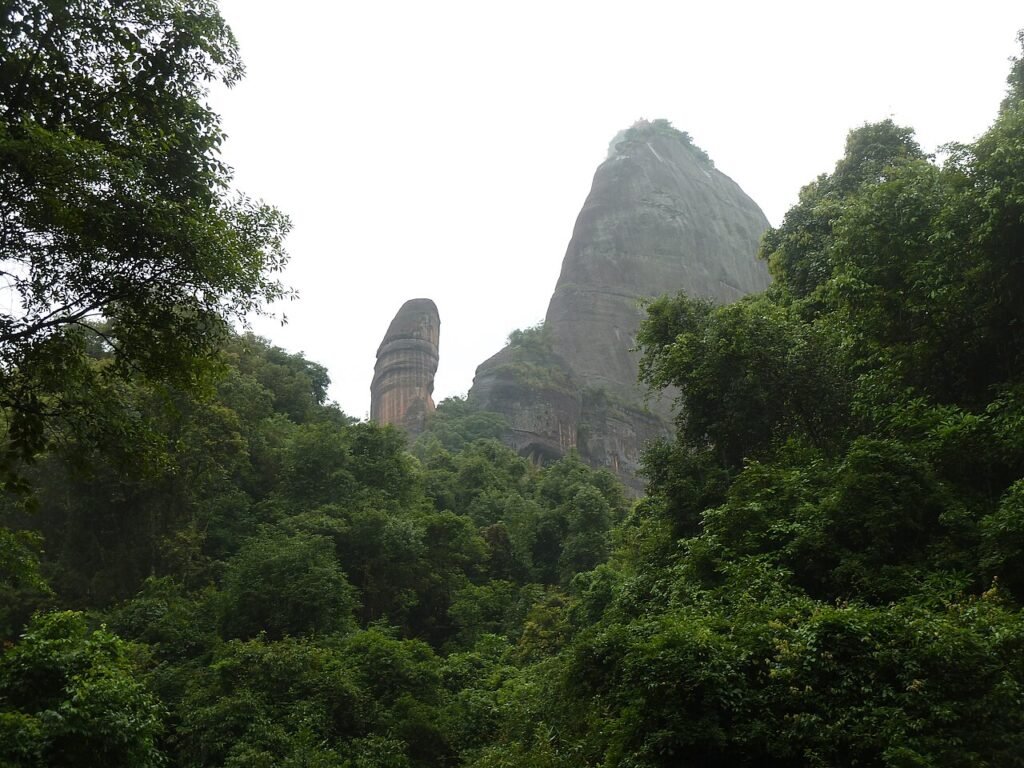
Danxia Mountain
The headline asset is Danxia Mountain (丹霞山), a UNESCO Global Geopark and World Natural Heritage site known for its red sandstone peaks, pillars, and eroded formations shaped over millions of years. It offers marked trails, lookout platforms, and short cable-car sections rather than remote trekking, which makes the scenery accessible to most fitness levels. The interest is geological as much as visual, and the site is large enough to occupy a full day. For a Guangdong route, Danxia is the strongest single nature counterpoint to the delta’s cities and the reason most travellers make the northern journey.
Nanhua Temple
The other pillar is Nanhua Temple (南华寺), one of the most significant Chan (Zen) Buddhist monasteries in China, associated with the Sixth Patriarch Huineng and located a short drive from the city. It is a working temple with halls, pagodas, and chanting, offering a contemplative counterpoint to Danxia’s outdoor exertion. The temple rewards a half day of slow walking through its courtyards and side lanes. For travellers interested in religious heritage, it is the most substantial such site in northern Guangdong and pairs naturally with a mountain day.
Who Shaoguan suits
Shaoguan suits travellers who want landscape and heritage away from coastal megacities, and who are content with a base city and day excursions. It appeals to hikers, photographers, and those interested in Buddhism, and it works as a cooler summer alternative to the delta. It is less suited to anyone expecting dense urban attractions, major shopping, or beach scenery; its strengths are natural and contemplative. The city also carries deeper history, with ancient passes and migration lanes, but these are secondary to the mountain and temple.
Sequencing within the region
Shaoguan lies well north of Guangzhou, reachable by high-speed rail, which makes it a northern branch rather than part of the Shenzhen–Hong Kong corridor. A common pattern is a Guangzhou base with a northern rail leg to Shaoguan for two or three nights, then a return south. It does not combine efficiently with the eastern or western delta coast without long backtracking, so keep it as the northern outlier of a Guangdong route. For longer routes it can lead toward Hunan or Jiangxi, but for a standard loop it is the scenic far north.
Practical notes
- Shaoguan is the northern gateway of Guangdong, with cooler, more mountainous terrain than the delta.
- Danxia Mountain is a UNESCO Global Geopark and World Natural Heritage site of red sandstone formations.
- Nanhua Temple is a major Chan Buddhist monastery associated with the Sixth Patriarch Huineng, near the city.
- The city centre is a practical base for excursions rather than a walkable attraction in itself.
- Shaoguan suits a two- or three-night northern extension focused on mountain and temple.
- It lies north of Guangzhou by high-speed rail; keep it as a northern branch, not a delta through-stop.
- Confirm current site opening days, ticket rules, and any reservation needs on official sources before travel.