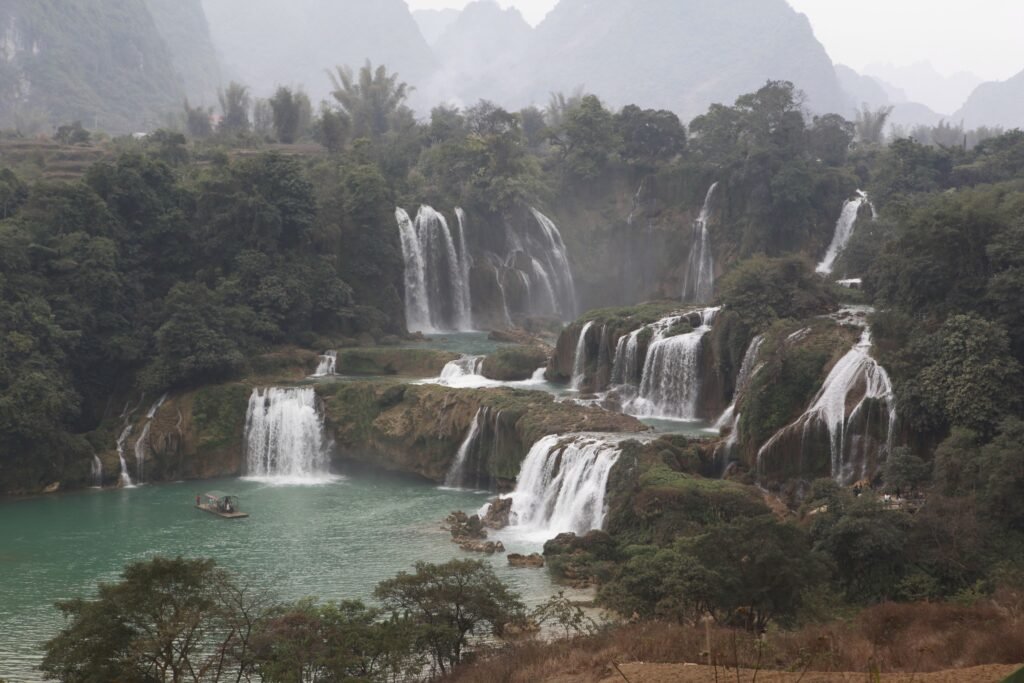
The Detian Transnational Waterfall (德天瀑布) sits on the Guichun River where Guangxi meets Vietnam, and it shares its flow with the Ban Gioc fall on the other side of the border, making it the largest transnational waterfall in Asia by the usual billing. For a South China route, Detian is the one place where a natural spectacle and a live international border sit in the same frame, and it anchors the western, borderland chapter of a Guangxi trip based out of Nanning.
A waterfall on the national line
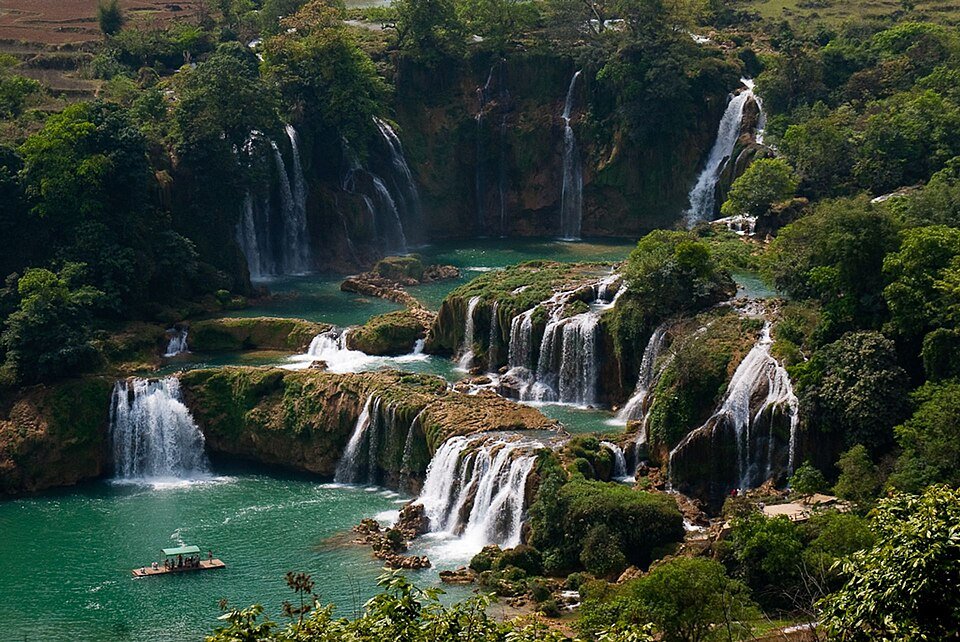
Detian is not a single drop but a wide, multi-tier fall spread across the river, backed by karst hills. The water comes from the Guichun River, which loops out into Vietnam and returns, so the fall and Ban Gioc are physically one system split by the frontier. The setting is dramatic in the wet season and thinner in the dry, but the border context is constant: a Vietnamese village is visible across the water, cross-border trade happens at a designated zone, and the whole scene reads as frontier landscape rather than a contained park.
What Detian is actually good for
The obvious product is the waterfall view from the Chinese side, reached by a scenic-area shuttle and a series of viewing terraces, with the option of a bamboo raft on the border river for a closer look. Around it, the area bundles karst scenery, a “hundred-li landscape gallery” along the river, and a cross-border street with food and crafts. A newer night show extends the visit after dark. The draw is the combination — volume, border, and karst — more than any one element, and it is strongest when the river is full.
Who it suits
Detian suits travellers who already value Chongzuo’s borderland character and want its signature sight, plus photographers who time the wet season for maximum flow. It fits a private-transfer or self-drive plan, because the fall is deep in Daxin county, far from any major city. It is less good for independent backpackers without a car, for visitors who dislike crowds at peak times, and for anyone expecting a wilderness hike — Detian is a managed scenic area, not a trailhead. The border novelty is real but rules-bound.
The cross-border dimension
Detian is the Chinese side of a China–Vietnam cross-border tourism zone, and that is both its distinction and its complication. Crossing or even stepping onto the Vietnam side has followed a booked, time-limited, group-based model that has changed since the zone’s formal operation, so it should never be assumed. The safe planning assumption is to enjoy the Chinese-side viewing and treat any Vietnam component as conditional on current official permission. The frontier is the attraction; the frontier is also the constraint.
How it fits the wider southern route
Detian is the western anchor of a Chongzuo loop out of Nanning, normally paired with Mingshi (明仕田园) a short drive away. The clean shape is Nanning → Mingshi → Detian → (Friendship Pass or Huashan) → Nanning. It is far west of Guilin and Liuzhou and has no link to Beihai or to any Fujian destination. Plan it as a two-to-three-night borderland extension of a Nanning stay, not as a through-stop, because the fall alone with transfers needs a full day and an overnight nearby makes the timing sane.
Practical notes
- Detian is in Daxin county, Chongzuo; reach it by road from Nanning, often via Mingshi. Confirm current transfer options via official sources.
- The fall is a managed scenic area with shuttles and viewing terraces; verify ticket and shuttle arrangements before going.
- Water volume tracks the season — strongest in the warmer, wetter months; check the current flow outlook.
- The Vietnam-side (Ban Gioc) cross-border zone follows changing rules; confirm any access through official sources and do not assume it.
- A border river raft is offered on the Chinese side; verify operation and limits locally.
- Pair Detian with Mingshi as an overnight loop; the fall alone with same-day returns is a long day.
- Carry your passport; identity checks are normal near the frontier.
- Allow two to three nights for the Chongzuo borderland chapter if adding Detian, Mingshi, and one heritage site.