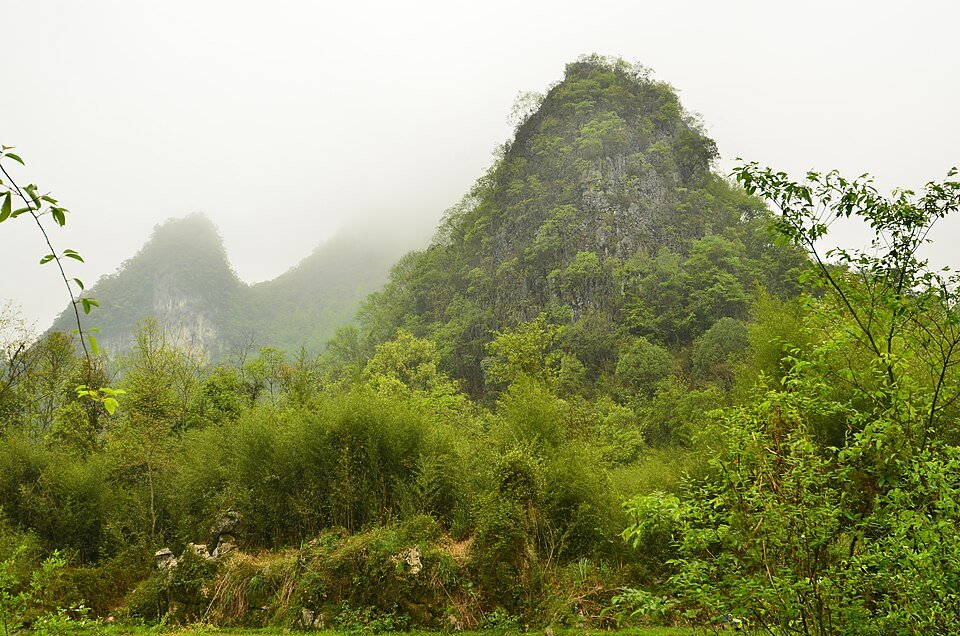
Libo is one of the easier remote-natural destinations in Guizhou to reach, but its layout still rewards a little sequencing. This guide covers how to arrive, how long to stay, when to go, and how to place Libo in a route centred on Guiyang rather than Kunming.
How to reach Libo
The decisive change in Libo’s accessibility was the high-speed rail line to Libo station, which connects the county to Guiyang in around an hour. From the station, shuttle buses or local transport run to the Xiaoqikong scenic zone; confirm the exact routing and fare with current official sources, as services change. Before the rail link, most visitors came by long-distance bus from Guiyang, a slower option that still exists. There is also road access from the Guangxi side for travellers approaching from Guilin or Hechi, but that is a longer surface journey.
How long to allow
A single rushed day is possible if you only want the Xiaoqikong corridor, but it misses the point. Plan at least one full day inside the scenic area and a second day if you want Maolan forest or a slower pace with a village visit. Two nights in or near Libo is the realistic minimum for a South China route that is not in a hurry. The scenic area is walked end to end, so fatigue, not distance, is the constraint.
Best months and weather
Libo’s subtropical karst climate means warm, humid summers and mild winters, with an annual average often quoted around 18°C. Spring through early autumn is the reliable window: water levels are good for the waterfalls, and the forest is green. Summer brings the heaviest rain and the largest crowds, so expect slick boardwalks and busy paths. Winter is quiet and cooler but less dramatic at the water features. Check current official sources for any seasonal closures tied to flooding or maintenance.
Sequencing with Guiyang and the wider south
Libo belongs beneath Guiyang, not Kunming. A natural order is Guiyang → Libo (1–2 nights) → north toward Huangguoshu and the minority regions, or Libo → Guangxi if you are crossing into Guilin country. If your route is Kunming-led, Libo is a detour east that only makes sense if you are already committed to covering both Yunnan and Guizhou; otherwise keep it on the Guiyang side. Because the rail ride is short, Libo can sit at either the start or the end of a Guizhou loop without adding a travel-heavy day.
Getting around on the ground
Inside the scenic area you move on foot along boardwalks, with shuttle buses linking the entrances and major stops. The Xiaoqikong route is usually walked from one gate to the other rather than as a loop, so decide which direction suits your energy. Maolan is different: it is a nature reserve with less infrastructure, where independent hiking may require a local guide and verified access. Local transport between Libo town, the station and the gates is informal and variable, so confirm times the day before.
A note on combining Libo with the rest of Guizhou: the county works as either the first or last stop on a Guiyang loop, but not comfortably as a midpoint if you are also going west to Huangguoshu and beyond. The rail from Guiyang is short enough that backtracking costs little, so build the loop as Guiyang in and out of Libo rather than forcing a linear path. If you are arriving from Guangxi, enter via Libo and exit via Guiyang to avoid a long southern transfer. This flexibility is Libo’s main logistical advantage over more remote karst destinations, and using it well removes most of the stress from the drive times.
Practical notes
- Book rail to Libo station in advance in summer and holiday periods; check current official sources for schedules.
- Stay at least one night; a day-trip from Guiyang is possible but leaves little time for Maolan or villages.
- Carry rain gear and non-slip footwear — boardwalks are wet year-round and crowded in summer.
- Verify Maolan reserve access, guide rules and any permit needs before relying on it as a plan.
- Treat all entry, shuttle and boat pricing as changeable; confirm with current official sources.
- If crossing to Guangxi, check road conditions and border-region travel rules before committing.