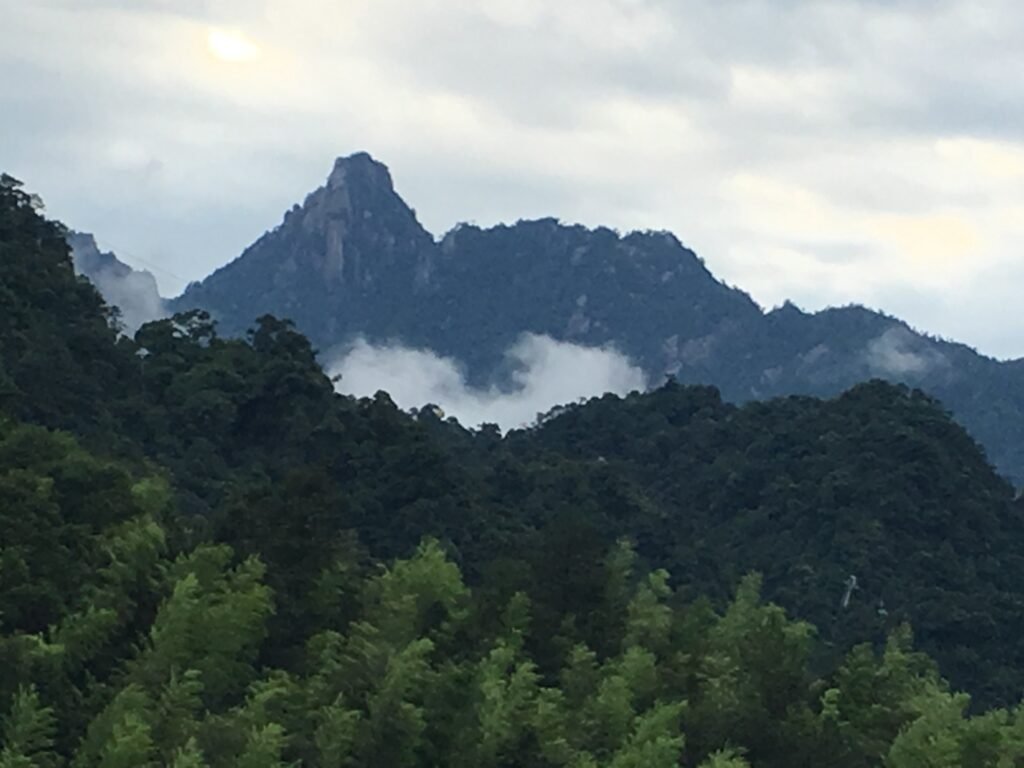
Sanqing Mountain, in northeastern Jiangxi near Shangrao, is a granite-peak UNESCO World Heritage site and one of the most distinctive mountain landscapes in the south. It earns a place on a South China route for travellers who want dramatic rock spires and Taoist heritage without the altitude or crowds of the Tibetan plateau.
What Sanqing Mountain actually is
The mountain is a national park centred on a body of late-Yanshan granite that has eroded into sharp pillars and sculpted peaks. It was inscribed as a UNESCO World Heritage site in 2008, recognised for both its natural form and its long Taoist association. The three main peaks — Yujing, Yuxu and Yuhua — give the mountain its name, referencing the Three Pure Ones of Taoism, and the highest, Yujing, reaches about 1,819 metres. Unlike the karst of Guizhou or the meadows of Wugong, this is a vertical, rocky landscape best seen from the cliffside boardwalks that loop the summits.
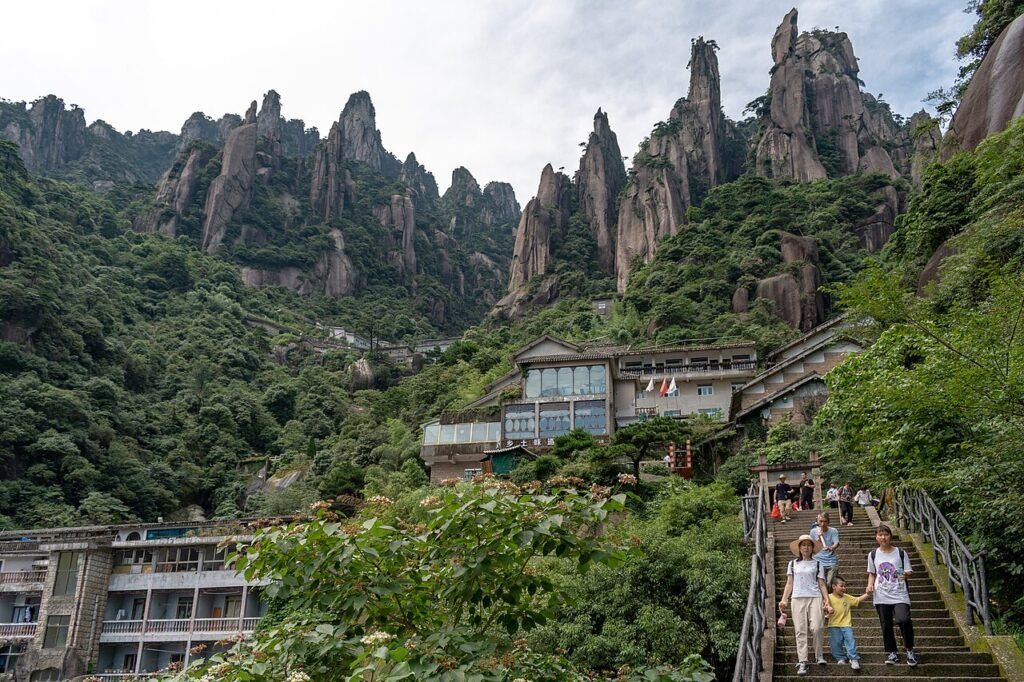
The natural draw: granite pillars and cloud sea
The signature sights are the freestanding granite formations — the “Oriental Goddess” and the “Giant Python” are the named examples — scattered along the high trails. Because the mountain sits in a humid southern climate, it frequently fills with cloud and mist, and theboardwalk sections known as the West Coast and Sunshine Coast are built precisely to show the peaks emerging from a sea of cloud. The experience is atmospheric and variable: on a clear day the spires are sharp; on a misty one the mountain becomes abstract and quiet. Either way, the rock shapes are the reason to come.
The cultural draw: a Taoist sacred site
Sanqing has been a Taoist site since the Eastern Jin, with the Sanqing Palace complex and associated shrines built into the high landscape. The pilgrimage logic — three peaks as three deities — still structures how visitors move through the mountain. This is not a monastery town like Shangri-La’s Songzanlin; it is a scattered set of ritual sites along the trails, and the cultural interest is in walking the same paths pilgrims have used for over a millennium rather than in any single building.
Who it suits
Sanqing suits fit walkers who enjoy a full day of ridge and boardwalk hiking, and travellers interested in geology or Taoist landscape. It pairs naturally with Jingdezhen and Wuyuan for a Jiangxi cultural-and-natural loop. It is a weaker fit for anyone who cannot manage several hours of walking at height, or for those who want a town base with evening strolling — Sanqing is a mountain excursion, not a settlement. Families with older children manage it; very young children and those with mobility limits will find the loop demanding.
How it fits a Jiangxi route
Sanqing sits in the northeast of the province, close to Shangrao and within reach of Jingdezhen, Wuyuan and Nanchang. A sensible order is Nanchang → Jingdezhen → Wuyuan → Sanqing, or the reverse, keeping the mountain as one concentrated day or overnight rather than a multi-day base. It does not belong on a Yunnan or Guizhou route and should be treated as a Jiangxi highlight. Because the loop trail is long, plan the mountain as the physically heaviest day of the provincial visit.
For a route planner, the comparison with Wugong to the west is useful. Both are Jiangxi mountains, but Sanqing is a vertical granite spectacle best seen from engineered boardwalks, while Wugong is an open meadow ridge meant for walking and camping. They do not substitute for each other, and trying to do both in a single compressed Jiangxi trip usually shortchanges the loop trail that is Sanqing’s point. Pick Sanqing when you want rock and cloud, and save Wugong for when the group wants a high, open summit and a night under the stars, rather than attempting both as a single mountain item.
Practical notes
- Sanqing is a granite peak park; the main loop is long, so gauge your fitness before committing to the full circuit.
- The named rock formations and cloud sea are weather-dependent — clear and misty days both have merit.
- Taoist sites are along the trails, not concentrated in one compound; walk the loop to see them.
- The mountain is a day or overnight excursion, not a town; base below or on the mountain as preferred.
- Combine naturally with Jingdezhen and Wuyuan for a balanced Jiangxi itinerary.
- Confirm all entry and cable-car pricing with current official sources before travel.