Ganzhou sits in southern Jiangxi, where the Zhang and Gong rivers meet to form the Gan, the province’s namesake waterway. It earns a place on a South China route as the best-preserved Song-dynasty city in the south, a working urban centre where walls, gates and a floating bridge have survived for a millennium.
What Ganzhou actually is
Ganzhou is a prefecture-level city with a core that flourished in the Song dynasty and has been continuously occupied since. It carries the nickname “Jiangnan Song City” and was named a National Historical and Cultural City in 1994. Unlike a restored tourist town, Ganzhou is a living city whose heritage sits inside everyday streets, which is precisely its appeal: you walk a Song wall and then step into a normal neighbourhood. The scale is city, not village, so the visit is about layers and continuity rather than a single set piece.
The wall and the gates
The defining feature is the Song-dynasty brick city wall, described as the best-preserved of its kind in China. Sections survive along the rivers, with the wall running from Xijin Gate past Bajingtai to the east, averaging several metres in height and carrying inscribed bricks from the Song through the republican era. The wall still links real gates — Jianchun, Yongjin and others — and walking its length along the water is the clearest way to read the city’s age. It is defensive architecture that happens still to define the riverfront.
The towers and the floating bridge
At the northeast corner, Bajingtai (Eight Views Terrace) stands on the wall where the two rivers converge, a reconstructed Song-style tower that frames the classic “eight views” of the city. Nearby, Yugutai (Lonely Hill Terrace) sits on Helan Hill and carries a literary history reaching back to the Tang, associated above all with the Southern Song poet Xin Qiji. Down at the river, the Jianchunmen floating bridge is a functioning span of around a hundred boats linked by chain, still used by locals — a piece of living infrastructure rather than a museum object.
The cultural depth: grottoes and old lanes
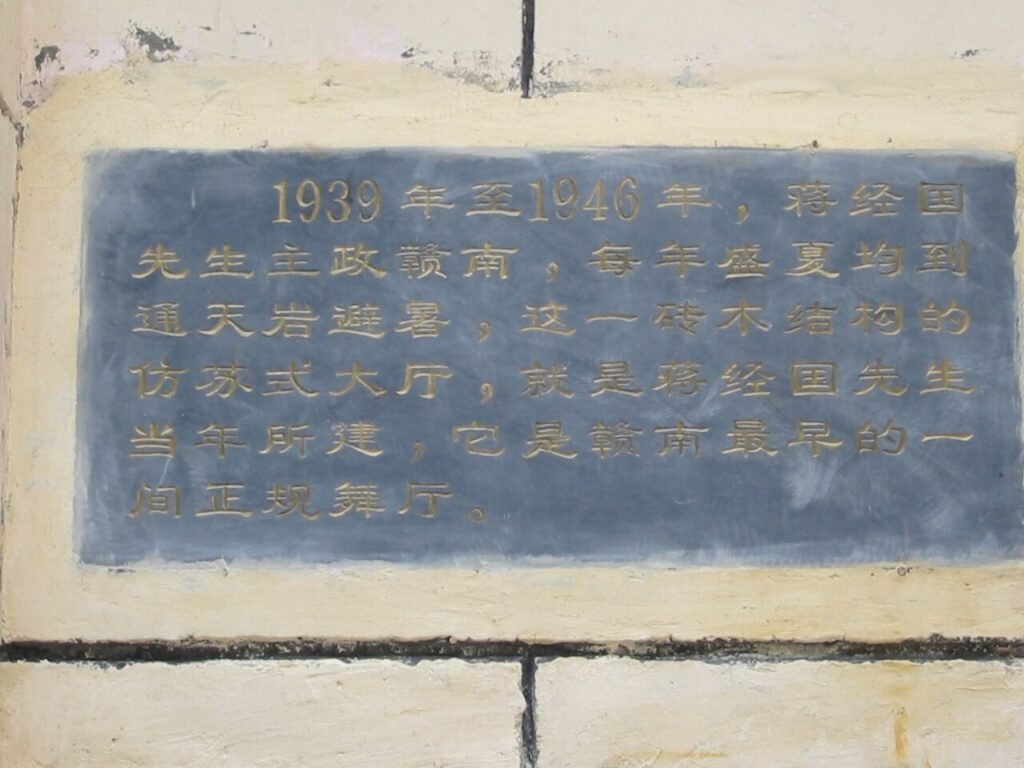
A few kilometres northwest of the centre, Tongtianyan is a hillside complex of Tang-and-Song cliff carvings and Buddhist images, described as the largest grotto site in the south. Back in the old city, lanes such as Zao’er Lane preserve mixed late-imperial architecture, and the Fushou drainage system shows how the Song city managed its water. The point is density: within a compact core Ganzhou stacks walls, towers, grottoes, a floating bridge and old lanes, which makes even a short stay feel substantial.
Who it suits
Ganzhou suits travellers interested in urban history, defensive architecture and the continuity of a Chinese city across a thousand years. It is good as a southern Jiangxi anchor after Nanchang or Jingdezhen, and for visitors who like walking cities more than climbing mountains. It is a weak fit for anyone expecting dramatic natural scenery as the main event, since the draw here is built and historical. Food travellers do well — Ganzzhou is a centre of Gan cuisine and Hakka influence.
Ganzhou also functions as a useful southern anchor because it is a real transport hub, not a dead-end town. From here you can continue toward the Guangdong border or loop back north, which gives a Jiangxi route a clean southern close without a long backtrack. For travellers coming from, or heading to, the Pearl River delta, Ganzhou is the natural handover city between Jiangxi heritage and Guangdong. That practical role is worth naming when you build the route, because it lets Ganzhou be both a destination in its own right and a logical point at which to change direction.
Practical notes
- Ganzhou is a living city; the heritage is scattered through the old core and along the rivers, not fenced into one site.
- The Song wall is walkable along the water; Bajingtai and Yugutai are the two main towers to climb.
- The Jianchunmen floating bridge is in daily use — go early or late for the calmest walk.
- Tongtianyan grottoes lie outside the centre; budget transport time if you want them.
- Zao’er Lane and the Fushou drainage exhibits show the old city’s street and water history.
- Confirm any tower or site admission with current official sources before travel.