Wugong Mountain rises on the Jiangxi–Hunan border in the Luoxiao range, with its highest point, Baihefeng (Golden Summit), at about 1,918 metres. It earns a place on a South China route for its rare high-altitude alpine meadows, which make it a different kind of southern mountain from the granite spires of Sanqing or the limestone of Guizhou.
What Wugong Mountain actually is
Wugong is a large mountain area spread across Pingxiang and neighbouring jurisdictions, centred on a summit plateau rather than a single peak. The distinctive feature is the meadow: above roughly 1,600 metres the slopes open into rolling grassland that is unusual at this latitude, where most mountains are forested to the top. The mountain also carries a long Taoist and Buddhist history, with ancient altar groups near the summit said to be around 1,700 years old. Administratively it is a national scenic area, geological park and natural-heritage site rolled into one.
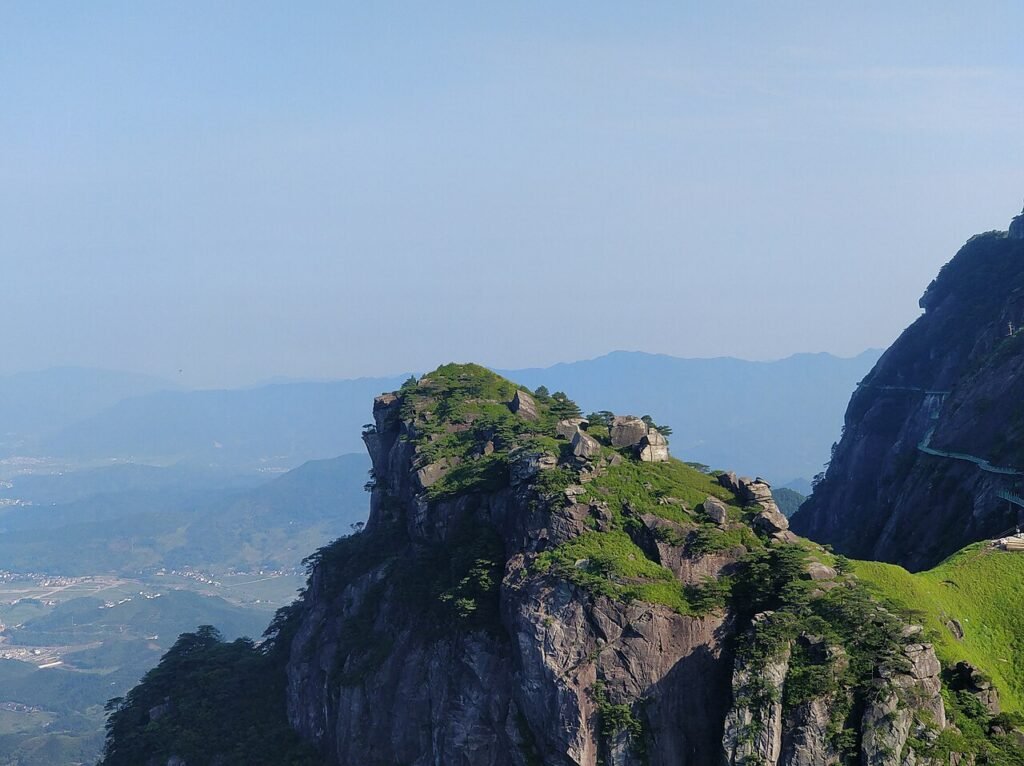
The natural draw: alpine meadows and cloud sea
The headline experience is walking the grassy ridge. The ten-thousand-mu meadow stretches along the summit, turning green in late spring and gold in autumn, with the open ground giving wide views that forested peaks cannot. Above the grass, the mountain is known for cloud sea at sunrise and for dark, star-filled skies at night, which is why camping on the plateau has become its signature activity. The scenery is big-sky rather than vertical: you come for openness and weather, not for tight rock formations.
The activity draw: hiking and camping
Wugong has become an outdoor destination, and the classic experience is a multi-day traverse on foot, with famous sections such as “Despair Slope” and “Hero Slope” marking the harder stretches. For less committed visitors, two tiers of cable car reduce the climb, and the Golden Summit area is reachable without a full traverse. The trade-off is that the easy version shows you the meadow and the summit but not the wild ridge walk that makes the mountain famous, so decide early which kind of visit you want.
Who it suits
Wugong suits hikers, campers and travellers who like weather-driven landscapes and open summits. It is strong for people who found Sanqing too contained, or who want a night under the stars as part of the trip. It is a poor fit for anyone needing hotels and settled town life at the top — summit accommodation is basic, often a guesthouse or a tent — and for travellers who dislike cold, wet, changeable conditions. Families can do the cable-car version, but the traverse is for prepared hikers.
How it fits a Jiangxi route
Wugong sits in western Jiangxi, away from the Nanchang–Jingdezhen–Wuyuan axis, so it needs its own slot rather than a waypoint. The access hub is Pingxiang, reached by high-speed rail, with buses onward to the scenic area. It does not combine neatly with Sanqing in a single day and should be its own 1–2 night stop. Keep it within Jiangxi planning; it has no natural place on a Yunnan or Guizhou route.
Wugong’s rise as an outdoor brand also brings crowding at peak times, and that is worth weighing against the solitude the meadow promises. The Golden Summit area in particular can be busy on holiday weekends, which undercuts the open-sky feeling that draws people in. If quiet matters, aim for a weekday or the shoulder of the season, and consider the traverse rather than the cable-car crowd. The mountain is large enough that the busy node is avoidable with a little planning, but only if you know it exists before you arrive and route around it rather than arriving blind on a national holiday.
Practical notes
- Wugong is defined by its high meadow and open summit, not by rock peaks — set expectations accordingly.
- The mountain is an outdoor site; summit lodging is basic (guesthouse or tent), not a hotel base.
- Ancient altar groups near the top reflect long Taoist/Buddhist use — walk the summit to see them.
- The grassy ridge is the draw; the cable-car version shows less of the famous traverse.
- Combine with Pingxiang access rather than with the eastern Jiangxi cultural towns.
- Confirm all entry, cable-car and camping pricing with current official sources before travel.