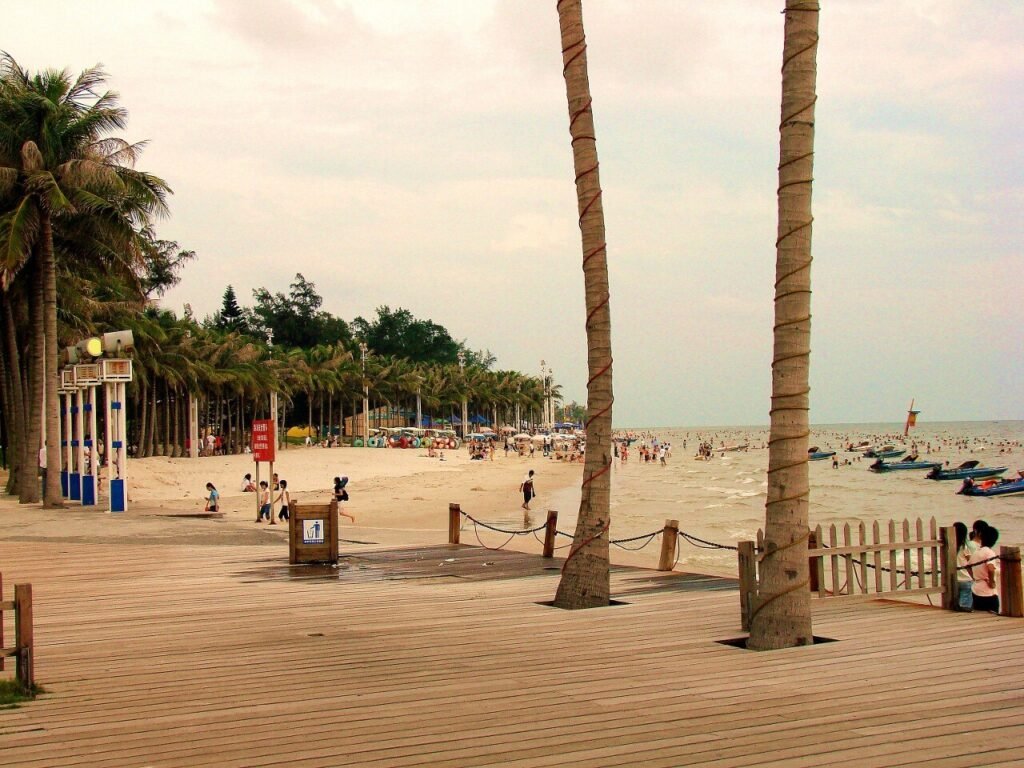
Beihai (北海市) is Guangxi’s window onto the Beibu Gulf, a flat coastal city whose main draws are a long pale-sand beach, a century-old arcade street, and — most importantly — the ferry gateway to Weizhou Island (涠洲岛). For a South China route built around karst and old towns, Beihai is the place to trade mountains for sea, and it works best as the coastal bookend of a Guangxi loop that starts inland.
A port city with a short, legible core
Beihai’s urban layout is simple: the Silver Beach (银滩) resort strip to the south, the Old Street (珠海路老街) and commercial centre to the north, and the ferry terminal that links the mainland to Weizhou Island. The city itself is not ancient, but the Old Street, built in the late 19th century, carries a mix of Chinese and Western arcade architecture from its treaty-port past, with former consulates and merchant houses along a walkable block. That contrast — a young seaside city with one genuinely old street — is the honest frame for a visit.
What Beihai is actually good for
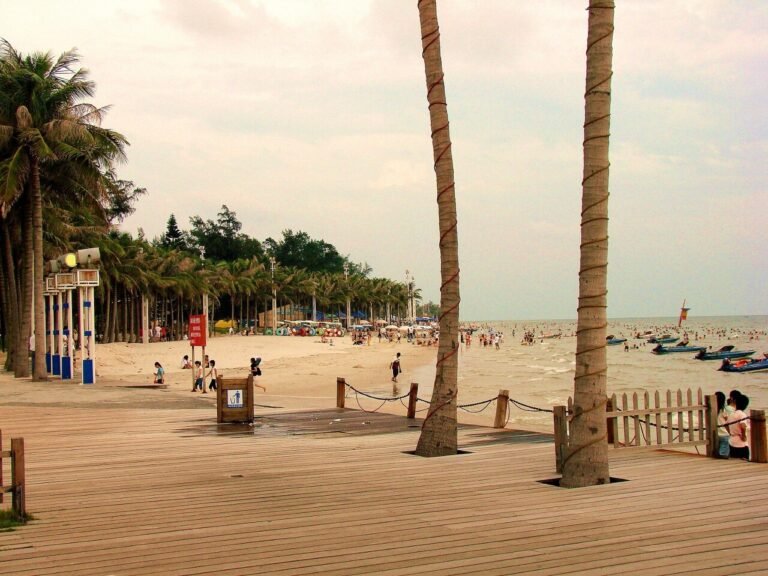
The beach is the headline. Silver Beach runs for many kilometres and is known for fine, light-coloured sand and a gentle shelving shore, which makes it a reasonable swim-and-walk destination rather than a dramatic one. The Old Street is the cultural anchor, good for an hour or two of architecture and snacks. Qiaogang (侨港) is a Vietnamese-influenced food street where returned overseas Chinese settled, and it is the most reliable place for a casual seafood and noodle meal. The real prize, though, is Weizhou Island, reachable by ferry from Beihai; the island is the largest volcanic island in China and the reason most travellers extend a Beihai stop beyond a single night.
Who it suits
Beihai suits travellers who want a low-effort beach-and-island segment without the cost or logistics of Hainan. It is good for families (the shallow beach, the mangroves at Golden Bay), for couples wanting a slower coastal few days, and for photographers who like volcanic coastlines and sunsets. It is less suited to visitors chasing dramatic scenery or deep heritage; the appeal is relaxed coast, not spectacle. Travellers prone to seasickness should note that the island crossing is a real boat ride, not a bridge.
The island is the point
Almost every Beihai itinerary is really a Beihai-plus-Weizhou plan. The island offers a volcanic geopark (Crocodile Mountain / 鳄鱼山), lava shores, a Catholic church, and quiet bays such as Wucai Beach (五彩滩) for sunrise and Dishui Danping (滴水丹屏) for sunset. Staying on the island for two or three nights is what turns Beihai from a pass-through into a destination. Treating the city alone as the goal usually leaves visitors underwhelmed; the sea, not the street, is the product.
How it fits the wider southern route
Beihai is the southwestern tail of a Guangxi route. The normal logic is to arrive overland from Nanning (a few hours by rail or road) after the Guilin–Liuzhou–Chongzuo inland stretch, then fly or rail out, or reverse the order. It does not sit naturally on a Guangzhou–Guilin line; it is a deliberate detour to the coast. For Fujian-bound routes it is irrelevant — Quanzhou and the Tulou are a separate province and a separate trip. Plan Beihai as the rest-and-sea chapter, not as a transit point.
Practical notes
- Reach Beihai by high-speed rail from Nanning or by air; confirm current services via official channels.
- Weizhou Island requires a ferry from Beihai plus an island entry pass; check current booking windows and weather-dependent sailings before committing.
- Silver Beach and the Old Street are free to access, but verify any shuttle, museum, or facility charges on official sources.
- Best months are typically April–November for swimming; Beihai has a long warm season and little true winter.
- Typhoon season (summer into early autumn) can cancel ferries; build buffer days if the island is essential.
- Qiaogang is the easiest casual-food cluster; seafood is widespread but price and freshness vary, so confirm before ordering.
- Allow at least two nights on Weizhou if the island is the goal, plus a mainland night for the ferry buffer.