Chongzuo (崇左市) is a prefecture in the far southwest of Guangxi, along the border with Vietnam, and it is the base for two of the region’s most distinctive sights: the Detian Transnational Waterfall (德天跨国瀑布) and the karst farmland of Mingshi (明仕田园). For a South China route, Chongzuo is not a city stop so much as a landscape-and-border chapter, best entered from Nanning and paired with the nearby waterfall and terrace scenery.
A border prefecture, not a city break
Chongzuo’s “attractions” are scattered across its counties rather than gathered in one downtown. The urban centre of Chongzuo itself is modest; the reasons to come are out in Daxin and Pingxiang counties. This matters for planning: the visit is really a loop of named sites — Detian, Mingshi, the Friendship Pass (友谊关), and the Huashan rock art (花山岩画) — connected by road. Travellers expecting a walkable city core will be disappointed; those expecting a drive-through borderland of peaks and rice will be satisfied.
What Chongzuo is actually good for
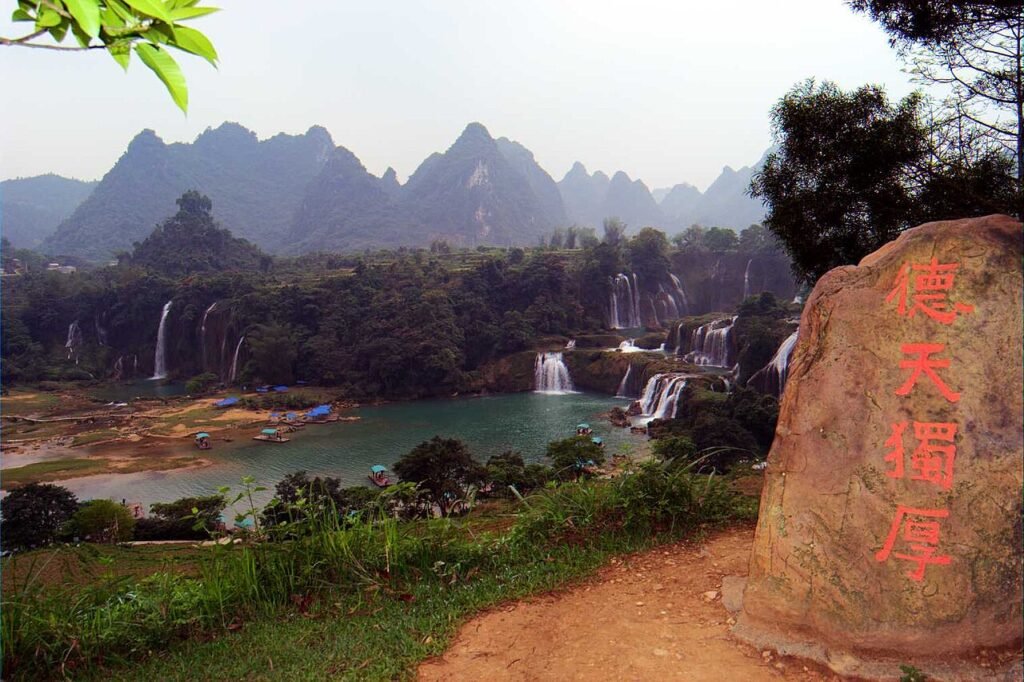
Detian is the headline: a wide waterfall on the Guichun River that forms the border with Vietnam and connects with the Ban Gioc fall on the other side, marketed as the largest transnational waterfall in Asia. Mingshi is the gentler counterpart, a flat karst valley of paddies and bamboo where a bamboo raft on the Mingshi River is the standard way to take it in; it is often described, fairly, as a quieter “small Guilin.” Beyond these, the Friendship Pass is a 2,000-year-old border gate with real military history, and the Huashan rock art is a UNESCO World Heritage site of ancient red figures on a riverside cliff, reached by boat. The cluster is coherent: waterfalls, karst, border history, and prehistoric art in one short arc.
Who it suits
Chongzuo suits self-driving or private-transfer travellers, because the sites are spread and public transport between them is thin. It fits photographers (the waterfall at high water, the Mingshi reflections), border-history enthusiasts, and travellers who want a slower, greener counterpoint to city routes. It is less good for anyone without a car or driver, and for visitors who want nightlife or dense urban culture. Families can manage it, but the distances between sites make a relaxed pace essential rather than optional.
The borderland character
What makes Chongzuo different from Guilin or Liuzhou is the frontier feel. You are close to Vietnam, the river is the national line, and the cross-border tourism zone at Detian–Ban Gioc is a genuine novelty in Chinese travel. That proximity also means more checks and more sensitivity around maps, permits, and crossing rules. The reward is a landscape that feels less curated than the headline Guilin corridor and a clearer sense of Guangxi as a border region, not just a scenic one.
How it fits the wider southern route
Chongzuo is almost always approached from Nanning, about two hours away by road, and it slots between Nanning and the Detian/Mingshi scenery to the west. A typical Guangxi ordering is Nanning → Chongzuo (Detian + Mingshi) →() back to Nanning → north to Liuzhou/Guilin, or Nanning → Beihai as the coastal tail. It does not belong on a Guangzhou–Guilin line and has no place in a Fujian route. Treat Chongzuo as a two-to-three-night western extension of a Nanning-based plan rather than a through-stop.
Practical notes
- Reach Chongzuo from Nanning by road or rail; confirm current services via official sources, as the prefecture is large and stations differ by county.
- Detian, Mingshi, the Friendship Pass, and Huashan rock art are in different counties; plan road transfers, not walks.
- Detian is a border site with a cross-border tourism zone; check current entry and crossing rules before relying on any Vietnam-side visit.
- Best water flow at the waterfall is generally the warmer, wetter months; verify the current seasonal guidance.
- A private car or driver is the practical way to link the scattered sites; public options are limited.
- Huashan rock art is reached by boat and is a World Heritage site; confirm sailing times and any booking need.
- Allow two to three nights for the Chongzuo chapter if you want Detian, Mingshi, and one heritage site without rushing.