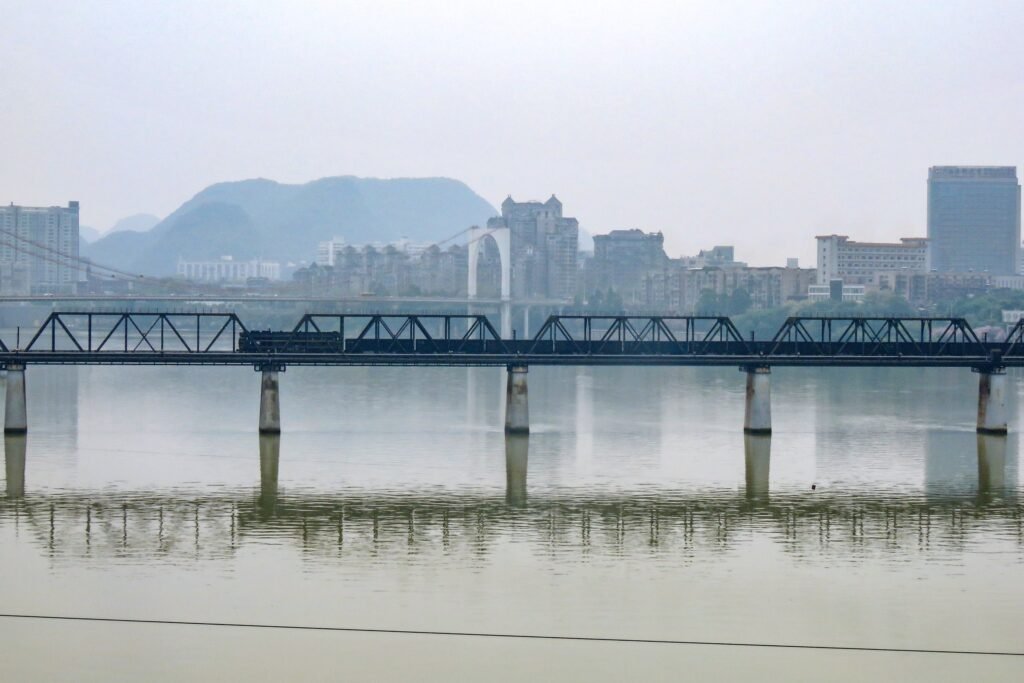
Liuzhou (柳州市) is a straightforward high-speed-rail hub in north-central Guangxi, which makes it one of the easier secondary cities in the region to slot into a private route. The planning questions are less about whether you can get there and more about how many nights it deserves and what season makes the river-and-peak setting worthwhile.
Reaching Liuzhou
Most travellers arrive by train. Liuzhou railway station sits close to the urban core, so the transfer from platform to hotel is short compared with cities where the rail station is on the outskirts. Direct high-speed services connect Liuzhou with Nanning, Guilin, and Guangzhou, among others, and the city also has an airport with domestic flights, though rail is usually the simpler default for a South China loop. Because services and fares shift, treat any specific train time as something to confirm rather than remember.
Rail versus air logic
For a route that already includes Guangzhou, Guilin, or Nanning, rail is almost always the better choice: it keeps you in the same booking ecosystem, avoids airport buffers, and drops you near the centre. Flying makes sense mainly if you are starting from a city with no convenient rail link or if you are combining Liuzhou with a flight into Guilin and an overland return. Budget-wise, the difference is rarely decisive; convenience and schedule density favour the train, and a rail arrival puts you within easy reach of the riverside sites that define the visit.
How long to spend
Liuzhou rewards a short, focused stay. One full day covers the riverside essentials: a morning or afternoon at Longtan Park, a walk through Liuhou Park, and an evening on or beside the Liu River for the lit skyline and fountain. Two nights let you add the Industrial Museum and a more relaxed meal circuit without feeling rushed. Three nights is only justified if you plan a side trip to the nearby Sanjiang Dong villages (程阳八寨) for wind-and-rain bridges and minority culture, which is a separate day’s commitment and a different transport leg.
Best months and weather
Spring (roughly March to May) is the most photogenic window, when the city’s bauhinia trees flower and temperatures are moderate. Autumn (September to November) is the other strong choice, with lower humidity and clear river light. Summer is hot, humid, and prone to heavy afternoon rain, which limits comfortable walking and makes the evening cruise the main outdoor option. Winter is mild by northern standards but can be grey and damp; the night river scene still works if the weather holds.
Sequencing with Guangzhou, Guilin, and Nanning
Liuzhou sits naturally between Nanning and the Guilin corridor. A common and efficient ordering is Guangzhou → Guilin (or Yangshuo) → Liuzhou → Nanning, or the reverse, letting the train carry you north to south without backtracking. If your route is Guangxi-only, Liuzhou works as a one-night palate cleanser between Guilin’s scenery and Nanning’s city bustle. It does not pair as cleanly with the coastal Beihai leg, which branches southwest from Nanning and adds distance, so keep it on the inland spine unless the itinerary explicitly includes the coast.
What to verify before travel
Tickets, boat schedules, and museum opening days are the items most likely to surprise you. The Liu River night cruise and the musical fountain run on seasonal timetables, and some museums close on a fixed weekday. Park entry is mostly free but can carry separate charges for lifts, boats, or special exhibitions. Cross-check all of this against current official sources rather than older blog posts, since Liuzhou has been actively reshaping its visitor offer and specific arrangements change.
Practical notes
- Book high-speed rail to Liuzhou railway station; confirm current schedules and platform details via official rail channels.
- Allow one to two nights; add a third only for a Sanjiang Dong-village day trip.
- Target March–May or September–November for comfortable weather and good light.
- Keep Liuzhou between Guilin and Nanning to avoid backtracking on a Guangxi loop.
- Verify Liu River cruise and fountain times locally, as they shift with the season.
- Check museum closure days (often a weekday) before planning indoor stops.
- Carry a backup plan for hot, rainy summer afternoons, such as the free museums.
- Confirm whether e-bike or ride-hailing apps need a China-compatible payment method.